

Quick answer: The three main types of resumes are chronological (work history listed newest first, best for most people), functional (organized by skills, for career changers or people with gaps), and combination or hybrid (skills summary plus full work history, for experienced professionals and career changers). Other types include targeted (customized for one specific job), mini (a short networking version), federal (detailed format for US government jobs), academic CV (for research and teaching roles), infographic or creative (design-heavy, for creative fields), video resumes, and nontraditional formats like portfolios and websites. For most job seekers, a tailored reverse-chronological resume is the safest choice.
Picking a resume type is a bit like picking an outfit for an interview. The classic option works almost everywhere, a few situations call for something different, and the neon jumpsuit is best saved for very specific occasions.
This guide walks through 10 different types of resumes, shows a short example of each, and helps you pick the right one for your situation.
The 3 Main Types of Resumes
1. Chronological (reverse-chronological) resume
What it is: Your work history listed from most recent to oldest, with achievements under each job.
Best for: Most job seekers, especially those with steady experience in the same field.
Pros: Recruiters' favorite, easy to skim, ATS-friendly, shows career growth.
Cons: Highlights employment gaps and job-hopping.
EXPERIENCE
Marketing Manager, BrightPath, 2023 – Present
- Grew email revenue 45% in one year
Marketing Coordinator, BrightPath, 2020 – 2023- Managed $500K in paid social at a 4x return on ad spend
See reverse-chronological resume.
2. Functional (skills-based) resume
What it is: Experience grouped by skill areas, with a brief job list at the end.
Best for: Career changers, people with long gaps, or scattered short-term work.
Pros: Puts transferable skills first.
Cons: Many recruiters distrust it; harder for ATS to connect skills to jobs.
RELEVANT SKILLS
Project Coordination: Planned 12 community events for 200+ attendees
Budgeting: Managed a $30,000 PTA budget with zero discrepancies
See functional resume.
3. Combination (hybrid) resume
What it is: A skills or qualifications summary at the top, followed by a full reverse-chronological work history.
Best for: Experienced professionals with diverse skills, career changers who still have relevant experience, and senior candidates.
Pros: Best of both worlds.
Cons: Can run long if you're not disciplined.
See combination resume.
Other Types of Resumes
4. Targeted resume
What it is: A resume heavily tailored to one specific job: the headline, summary, skills, and bullets all mirror the posting.
Best for: Any job you really want. Honestly, every resume should be somewhat targeted.
See resume keywords optimization.
5. Mini resume
What it is: A very short summary of your top qualifications, sometimes on a card or half page.
Best for: Career fairs, networking events, and quick introductions.
6. Federal resume
What it is: A detailed resume for US government jobs (USAJOBS), often 2–5 pages, with hours per week, salary, supervisor details, and specific qualifications.
Best for: Federal job applications. Follow the posting's instructions exactly.
7. Academic CV (curriculum vitae)
What it is: A comprehensive record of education, research, publications, teaching, grants, and presentations. Can be many pages.
Best for: Academic, research, and some medical roles. See graduate student CV, science CV, and publications on a CV.
8. Infographic or creative resume
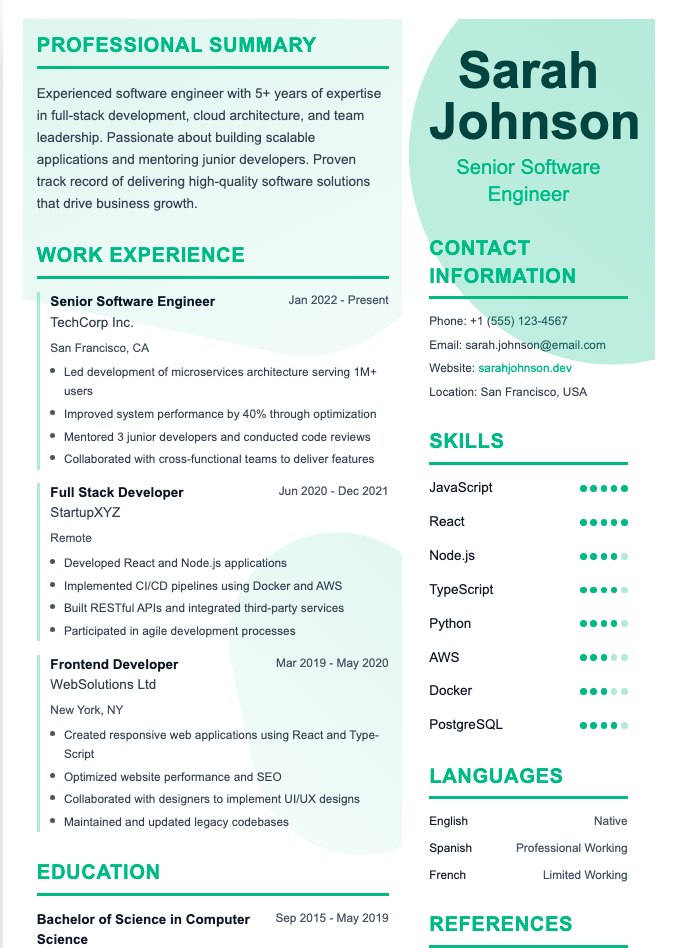
What it is: A visually designed resume using color, icons, charts, and unique layouts.
Best for: Graphic design, illustration, and some marketing roles, usually alongside a simple version for online applications.
Caution: Often unreadable by ATS. See creative resume examples.
9. Video resume
What it is: A short video (usually 1–2 minutes) introducing yourself and your qualifications.
Best for: On-camera roles, sales, and creative positions, or when an employer requests one. Use it as a supplement, not a replacement.
10. Nontraditional resumes (portfolio, website, LinkedIn)
What it is: A personal website, online portfolio, GitHub profile, or detailed LinkedIn profile that showcases your work.
Best for: Designers, developers, writers, photographers, and marketers. Link to it from your traditional resume. See how to add your resume to LinkedIn.
Other specialized formats include the Europass CV for European applications (see Europass CV) and the plain text resume for pasting into online forms (see plain text resume).
Which Type of Resume Should You Use?
- Steady career in one field: Chronological
- Recent graduate or student: Chronological with education first, or combination with projects
- Career changer: Combination (or functional, carefully)
- Long employment gap: Combination or chronological with a brief gap explanation. See how to explain employment gaps
- Many short-term or freelance jobs: Combination, grouping freelance work. See freelance work on a resume
- Senior or executive: Combination with a strong summary. See executive resume examples
- Government job: Federal resume
- Academic or research role: Academic CV
- Creative role: Chronological or combination plus a portfolio link (infographic optional)
- Networking event: Mini resume
When in doubt, choose chronological. It's the format recruiters expect and ATS read best.
How Each Resume Type Works With ATS
Applicant tracking systems read text and look for standard sections. Here's how each type tends to perform:
- Chronological: excellent. Clear job titles, dates, and bullets parse easily
- Combination: very good, as long as the skills section is followed by a standard work history
- Targeted: excellent. It's usually chronological, with keywords tailored to the posting
- Functional: fair. Some systems struggle to connect skills to specific jobs and dates
- Federal: good on USAJOBS, which is designed for it
- Academic CV: good in academic systems, but long CVs may be skimmed in corporate ATS
- Infographic/creative: poor. Text inside graphics, columns, and icons often can't be read
- Video and website resumes: not parsed at all, so always pair them with a standard resume
See what is a resume parser and ATS-friendly resume templates.
Resume vs. CV vs. Biodata
These terms are often confused:
- Resume: a concise 1–2 page summary tailored to a job (US and Canada standard)
- CV (curriculum vitae): in the US, a long, detailed academic record; in the UK, Europe, and much of the world, simply another word for resume
- Biodata: a format used in parts of South Asia that includes personal details like date of birth and family background. See what is biodata
Use the term (and format) the job posting asks for.
Can You Use More Than One Type of Resume?
Yes, and many job seekers should. For example:
- A chronological resume for online applications
- A creative or infographic version to hand out at interviews in design roles
- A mini resume for networking events
- A targeted version for each job you apply to
Just keep the facts (dates, titles, employers) consistent across all versions.
Frequently Asked Questions
What are the different types of resumes?
The main types are chronological, functional, and combination (hybrid). Others include targeted, mini, federal, academic CV, infographic, video, and nontraditional resumes like portfolios and websites.
Which type of resume is best?
For most people, the reverse-chronological resume. It's the most familiar to recruiters and the most ATS-friendly.
What type of resume is best for no experience?
A chronological resume with education first, or a combination resume that highlights skills, projects, and volunteer work. See entry-level resume examples.
What is the difference between a resume and a CV?
In the US, a resume is a concise 1–2 page summary of your experience, while a CV is a longer, detailed academic record. In the UK and much of Europe, "CV" simply means resume.
Do employers prefer a certain type of resume?
Most employers and recruiters prefer reverse-chronological resumes because they show a clear timeline of your experience. For a deeper comparison, see types of resumes.
Build the Right Type of Resume
Our Resume Builder offers ATS-friendly templates for chronological, combination, and skills-focused resumes, so you can pick the right format and start writing in minutes.