

Quick answer: A reverse-chronological resume lists your work experience from newest to oldest, so your current or most recent job appears first. It is the most common resume format, the one recruiters expect, and the easiest for applicant tracking systems to read. Use it when you have a steady work history and your recent roles match the job you want.
If resumes had a "default settings" button, it would produce a reverse-chronological resume. It is the plain white T-shirt of job applications: not flashy, fits almost everyone, and nobody has ever been rejected for wearing one.
This guide explains what the reverse chronological resume format is, when to use it, how to write each section, and how it compares to functional and combination formats.
What Is a Reverse-Chronological Resume?
Reverse-chronological simply means "newest first." In a resume, that applies to your work experience section (and usually education and certifications too). Your current or most recent role sits at the top, and each earlier job follows in descending order by date.
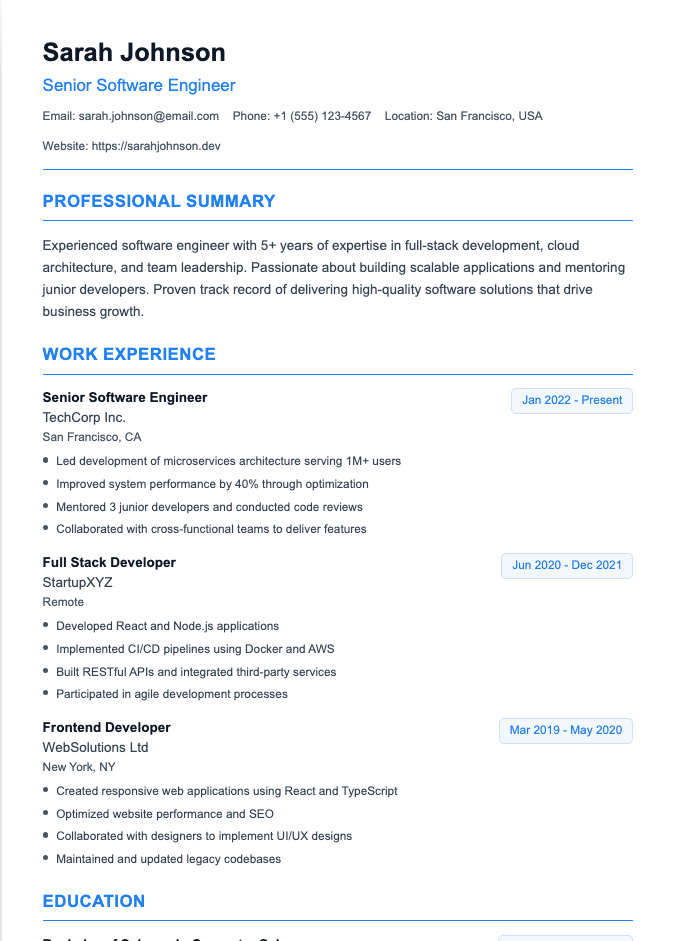
A standard reverse-chronological resume includes:
- Header with your name and contact details
- Professional summary (2–3 sentences)
- Work experience, newest to oldest, with job title, company, location, dates, and bullets
- Education
- Skills
- Optional sections like certifications, projects, or languages
Chronological vs. reverse chronological order
The terms are often used interchangeably on resumes, but they technically mean opposite things. Chronological order starts with the oldest event; reverse chronological starts with the newest. When a recruiter or template says "chronological resume," they almost always mean reverse-chronological. Nobody wants to start reading your career at your first summer job.
Why Recruiters Prefer This Format

Recruiters skim. The reverse-chronological format lets them answer their most important questions in seconds:
- What are you doing right now?
- Is your recent experience relevant to this job?
- Have you grown over time (promotions, bigger scope, more responsibility)?
- Are there gaps they should ask about?
It is also the most ATS-friendly format. Applicant tracking systems expect standard section headings and a predictable job-title, company, and date structure. For a deeper look, read the truth about ATS.
When to Use a Reverse-Chronological Resume
Use it if you:
- Have a consistent work history without major gaps
- Are applying for a role in the same field as your recent jobs
- Can show career progression (promotions, increasing responsibility)
- Are applying to traditional or corporate employers that expect a familiar layout
Consider adapting it (or using a combination format) if you:
- Are changing careers and your recent jobs are unrelated
- Have significant employment gaps you want to frame differently
- Have very little work experience (students and new grads)
- Are applying for academic or research roles, where a CV is usually expected
Even in these situations, most career experts suggest adapting the reverse-chronological format rather than abandoning it. Gaps can be explained honestly (see our guide on how to explain employment gaps), and students can move education or projects higher on the page.
How to Write a Reverse Chronological Resume (Step by Step)
1. Start with a clean header
Include your name, phone, professional email, city and state, and LinkedIn (or portfolio). A full street address is no longer necessary, and in the US a photo is not expected.
2. Write a short professional summary
Two or three sentences covering your job title or specialty, years of experience, and one or two strengths that match the posting. Write it last, after your experience section is done, so you can pull out your best points. Need help? See how to write a resume summary.
3. List work experience, newest first
For each role, include:
- Job title
- Company name and location
- Start and end dates (month and year, in a consistent format like "Jan 2023 – Present")
- 3–5 bullets for recent roles; fewer for older ones
Focus bullets on achievements, not duties. Use present tense for your current job and past tense for previous ones. Our guide on resume bullet points that turn duties into results shows exactly how.
4. Add education
List your highest degree first. Recent graduates can include GPA (if strong), honors, and relevant coursework, and may place education above experience. Experienced professionals can keep it to one or two lines.
5. Include targeted skills
List hard skills, tools, and certifications that match the job description. Show soft skills through your bullets instead of listing "team player" and hoping for the best.
6. Add optional sections only if relevant
Certifications, languages, volunteer work, or projects can strengthen your resume, but only if they support the job you are applying for. Keep them in reverse-chronological order too.
Reverse-Chronological Resume Example
Taylor Morgan
Seattle, WA · taylor.morgan@email.com · (555) 234-5678 · linkedin.com/in/taylormorganProfessional Summary
Marketing manager with 7 years of experience in B2B SaaS. Skilled at building demand-generation programs, managing paid budgets, and turning data into campaign decisions.Work Experience
Marketing Manager, CloudSuite Inc., Seattle, WA, Mar 2023 – Present
- Lead a team of 4 running paid search, email, and webinar campaigns
- Rebuilt lead-scoring model with sales, improving lead handoff quality
- Own a quarterly paid media budget and report ROI to leadership
Senior Marketing Specialist, BrightPath Software, Portland, OR, Jun 2020 – Feb 2023
- Launched an email nurture program for trial users
- Managed product launch campaigns for 3 major releases
Marketing Coordinator, Northwest Media Group, Portland, OR, Jul 2018 – May 2020
- Coordinated trade show logistics and event follow-up
- Produced weekly social content and performance reports
Education
B.A. Communications, University of Oregon, 2018Skills
HubSpot, Salesforce, Google Ads, LinkedIn Ads, SQL basics, A/B testing, copywriting
Notice how the reader can see the career progression (coordinator to specialist to manager) in about three seconds. That is the format doing its job.
Chronological vs Functional Resume vs Combination Resume Format
There are three main resume formats. Here is how they compare.
Reverse-chronological resume
- Structure: Work history newest to oldest, with dates and bullets for each role.
- Best for: Most job seekers with steady, relevant experience.
- Pros: Familiar to recruiters, ATS-friendly, shows growth clearly.
- Cons: Makes gaps and unrelated recent jobs more visible.
Functional (skills-based) resume
- Structure: Skills grouped into themes (for example "Project Management" or "Customer Relations") at the top; job history reduced to a short list, sometimes without dates.
- Best for: Rarely recommended today; occasionally used for long gaps or major career pivots.
- Pros: Puts transferable skills front and center.
- Cons: Many recruiters find it hard to connect skills to real jobs, and some read it as an attempt to hide something. ATS software can also struggle with it.
Combination (hybrid) resume format
- Structure: A prominent skills or "core competencies" section, followed by a full reverse-chronological work history.
- Best for: Career changers, people with gaps, and experienced professionals who want key skills visible up front.
- Pros: Highlights skills without hiding your timeline.
- Cons: Can run long and repeat information if you are not careful.
Bottom line on chronological vs functional resume: if you are unsure, choose reverse-chronological. If you need to emphasize transferable skills, choose the combination resume format before you consider a purely functional one. Career changers can learn more in our career change resume guide.
Tricky Situations (and How to Handle Them)
Overlapping jobs
If you held two jobs at the same time, list the one with the most recent end date first. If both are current, put the one most relevant to the target role first, or the one with the later start date.
Promotions at the same company
List the company once and stack your titles underneath, newest first, each with its own dates. This shows growth without repeating the employer name. For more, see how to show a promotion on your resume.
Your most recent job is less relevant
Keep it on the resume (removing it creates a gap), but shorten it to one or two bullets. Expand earlier, more relevant roles and lean on your summary and skills section.
Very long careers
Show roughly the last 10–15 years in detail. Older roles can go in a short "Earlier Experience" line without dates, or be removed. Your resume should not read like a historical novel.
Tips for a Stronger Reverse-Chronological Resume
- Tailor every application. Reorder bullets and skills to match the job posting's keywords.
- Keep dates consistent. Pick one format ("Jan 2023 – Present") and stick with it.
- Aim for 1–2 pages. One page for most early- and mid-career candidates; two for extensive relevant experience.
- Use standard headings. "Work Experience," "Education," and "Skills" beat creative labels for ATS parsing.
- Proofread with fresh eyes. Ask a friend to check whether your progression story is obvious at a glance.
Frequently Asked Questions
What does reverse-chronological mean on a resume?
It means listing your experience starting with your current or most recent job and moving backward in time. The same order is usually applied to education and certifications. It is the standard format most recruiters expect.
Do you put the most recent job first on a resume?
Yes. In a reverse-chronological resume, the most recent job goes first because it is usually the most relevant to the role you want. Recruiters want to see what you are doing now before anything else.
Is a chronological resume the same as reverse-chronological?
In everyday resume advice, yes. When people say "chronological resume," they almost always mean newest-first. Technically, chronological means oldest-first, but that order is almost never used for resumes.
What is the most common resume format?
The reverse-chronological format is the most widely used resume format. It works for most industries and experience levels, and applicant tracking systems read it reliably. The combination format is a common alternative for career changers.
When should you not use a reverse-chronological resume?
Consider a combination format if you are making a big career change, have long employment gaps, or have little relevant work history. Academic and research applicants usually need a CV instead. Even then, most people keep a dated, newest-first work history somewhere on the page.
Should education be in reverse chronological order?
Yes. List your highest or most recent degree first. Students and recent graduates can place the education section above work experience, while experienced candidates usually put it after.
How far back should a reverse-chronological resume go?
Most career advisors suggest about 10–15 years of detailed experience. Older roles can be summarized briefly or left off unless they are highly relevant to the job.
Build a Reverse-Chronological Resume in Minutes
Our Resume Builder uses the reverse-chronological structure by default, with ATS-friendly templates and AI suggestions for turning duties into achievements. Add your roles, and it keeps everything in the right order for you.