

Quick answer: No, you usually don't need your full street address on your resume anymore. List your city and state (e.g., "Austin, TX") instead. It tells employers where you're based and helps with location filters in applicant tracking systems, without exposing your home address. Include a full address only if the job posting asks for it, or for some government, security clearance, or local roles. If you're relocating, write "Relocating to [City] in [Month]."
There was a time when your resume needed your full address because employers would actually mail you a letter. Today, they'd sooner send a carrier pigeon. Recruiters contact you by email, phone, or LinkedIn, which makes your street address mostly decorative.
But "mostly" matters. Location still plays a role in hiring. This guide explains when to include an address, when to skip it, how to format it, and what to do if you're moving.
Why Resumes Used to Include a Full Address
Full addresses were standard for decades because:
- Employers mailed interview invitations and offer letters
- Hiring managers wanted to estimate commute times
- A complete address signaled a complete, "proper" resume
- Background checks started from the information on your resume
Email, online applications, and remote work have changed all of that. Employers who need your full address for paperwork or background checks will ask for it later in the process.
Reasons to Include Location on Your Resume
Leaving your location off entirely can backfire. Here's why at least your city and state are worth including:
- ATS location filters. Recruiters often search applicant tracking systems by city, state, or ZIP code. If your resume has no location, you may not show up for local roles.
- Local candidate preference. For on-site and hybrid jobs, employers often prefer people who won't need to relocate.
- Industry expectations. Government, construction, hospitality, and some traditional employers still expect an address.
- Salary context. Pay ranges often depend on location, so recruiters use it to set realistic expectations.
Reasons to Leave Your Full Street Address Off
- Privacy and identity theft. Resumes get uploaded to job boards, shared between recruiters, and stored in databases for years. Your street address doesn't need to be in all of them.
- Location bias. Hiring managers may make assumptions about your neighborhood or commute.
- Long commute concerns. An employer may quietly decide you live "too far," without asking whether you'd mind the drive.
- Wasted space. Two lines of address push down the content that actually gets you hired.
- Remote roles. For fully remote jobs, your street address is irrelevant. Your state or country (for tax and work eligibility) is usually enough.
How to Write Your Address on a Resume (4 Options)
Option 1: City and state (recommended)
Jordan Lee
Austin, TX | (512) 555-0148 | jordan.lee@email.com | linkedin.com/in/jordanlee
This works for most jobs and is what most recruiters expect today.
Option 2: City, state, and ZIP code
Austin, TX 78704
Useful if you're applying locally and want to show you're close by, since some ATS searches use ZIP codes.
Option 3: Full address
1234 Elm Street, Apt. 5
Austin, TX 78704
Only include this when the job posting or application specifically asks for it.
Option 4: Remote or region only
Remote | Based in Texas, USA
Good for remote roles, especially if you're open to working across time zones.
Formatting tips:
- Put your location in the main body of the page, near your name, not in a header or footer (some ATS skip those)
- Use the standard two-letter state abbreviation (TX, CA, NY)
- Keep it on one line with your phone, email, and LinkedIn URL
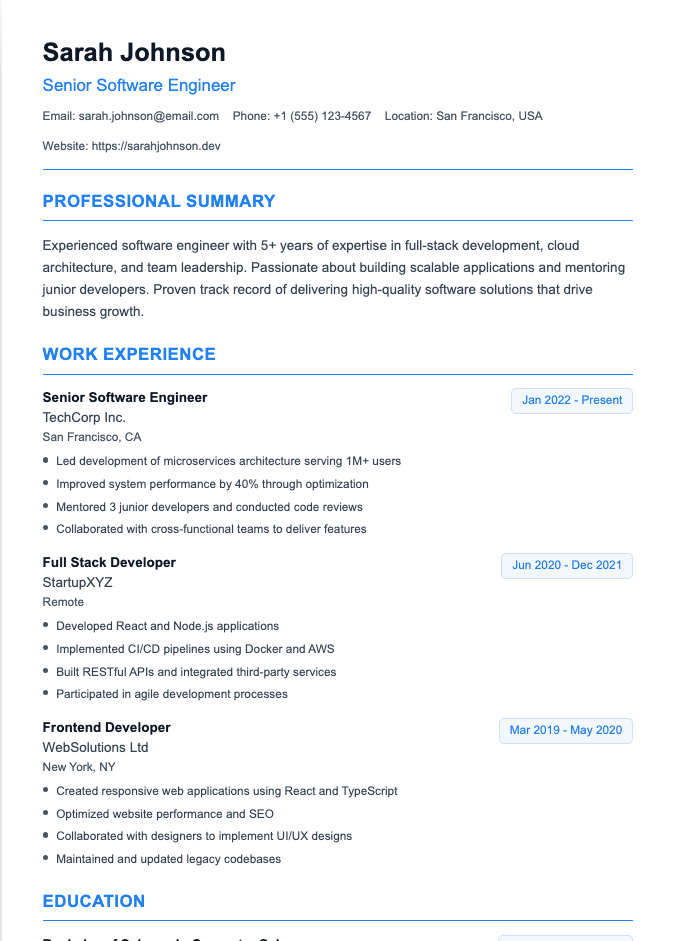
Here's an example of a clean resume header that uses only the city and country:
For more on the top section of your resume, see our guide to resume headings.
What If You're Relocating?
If you're moving to a new city, make it clear you'll be local soon. Otherwise, an ATS or recruiter may filter you out as non-local.
Jordan Lee
Relocating to Denver, CO (June 2026) | (512) 555-0148 | jordan.lee@email.com
Other options:
- "Open to relocation" if you're flexible about where you'll move
- Two locations: "Austin, TX / Relocating to Denver, CO"
- Mention it in your summary or cover letter: "Relocating to Denver in June and available for in-person interviews from May."
Only use a new-city address if you've actually committed to moving. Using a friend's address to look local can backfire if the employer asks you to come in tomorrow.

When You Should Include Your Full Address
- The job posting asks for it. Always follow the instructions.
- Government and federal jobs. Federal resumes and many public-sector applications require a full address.
- Security clearance roles. Background investigations need complete address history (usually on a separate form).
- Some licensed professions. Healthcare, education, and finance roles may ask for it at the application stage.
- Certain countries. Some countries and employers still expect a full address on a CV.
What About Application Forms and Background Checks?
Leaving your street address off your resume doesn't mean you'll never share it. Many online application forms have a required address field, and that's fine to fill in: it goes to the employer's system, not to every job board your resume gets posted on.
Background checks also need your full address, and often your address history, but they happen after an offer or late in the process, on a separate authorization form. That's the right time to share it.
A good rule of thumb: give your full address to a specific employer when they ask for it, and keep it off the resume that may be forwarded, uploaded, and stored by people you've never met.
Address Norms in Other Countries
Most top guides only cover US resumes, but expectations vary:
- US and Canada: city and state or province is standard.
- UK and Ireland: town or city and county (or postcode area) is common; a full address is optional.
- Australia and New Zealand: suburb and city or state is usually enough.
- Germany, France, and much of Europe: a full address is more commonly expected on a CV, along with other personal details. See our guide to the Europass CV.
- Parts of Asia and the Middle East: full addresses and more personal information are often expected. If you're applying in Singapore, see our Singapore resume templates.
When applying abroad, look at a few local job postings or CV samples to see what's normal.
Should You Put Your Address on Your Cover Letter?
In a traditional business letter format, your address goes at the top of a printed cover letter. Most cover letters are now sent by email or uploaded online, so the same rule applies as for your resume: your city and state, phone number, and email are enough. Keep your resume and cover letter headers consistent so they look like a matching set. See how to write a cover letter.
What Else Belongs in Your Resume Contact Section?
- Full name, the largest text on the page
- Phone number with a professional voicemail greeting
- Professional email (firstname.lastname@email.com, not partyanimal99@email.com)
- City and state
- LinkedIn URL, customized if possible
- Portfolio or website, if relevant to your field
Leave off: date of birth, marital status, photo (in the US, UK, and Canada), Social Security number, and personal social media.
Frequently Asked Questions
Should I put my address on my resume?
Usually, just include your city and state. Add a full street address only if the employer asks for it or you're applying for government or security clearance roles.
Is it OK to not put your address on your resume?
Yes. Leaving off your street address is completely normal. But include at least your city and state so employers and applicant tracking systems know where you're based.
Should I include my ZIP code on my resume?
It's optional. Adding your ZIP code can help with local ATS searches, but city and state are enough for most jobs.
What do I put if I'm moving to a new city?
Write "Relocating to [City, State]" with a month if you know it. You can also mention your move and availability in your summary or cover letter.
Should I put my address on a resume for a remote job?
No street address is needed. Listing your city and state, or "Remote, based in [State]," is enough to show work eligibility and time zone.
Can my address affect my chances of getting hired?
Yes. Some employers filter by location or worry about long commutes, and addresses can trigger bias. Listing only your city and state reduces that risk while still showing you're local.
Build a Clean, Modern Resume Header
Our Resume Builder formats your contact details the modern way, with name, city, phone, email, and LinkedIn on one clean line, so recruiters (and applicant tracking systems) can find you instantly.