

Quick answer: A CV European style usually refers to the Europass CV, the European Union's free standardized curriculum vitae format available in 31 languages, or a modern 1–2 page tailored European CV. Use the official Europass layout when required by EU institutions, universities, public-sector bodies, or Erasmus+ programs; use a concise custom CV for private-sector and tech jobs.
If you are applying for a job, master's degree, or internship in Europe, someone has probably told you to make a "CV European style." Usually, they mean the Europass CV—the official European Union format designed to make qualifications easy to compare from Lisbon to Helsinki.
The catch? While the Europass CV is loved by universities, government agencies, and grant committees, sending its rigid template to a fast-moving tech startup in Amsterdam or Berlin can make your application blend into a sea of identical blue headers.
This guide explains how the official European CV format works, how to build one step by step, country-by-country rules on photos and personal details, and a copy-ready European CV template you can adapt for any employer.
What Is a CV European Style (and Is It Always Europass)?
When employers or universities ask for a CV European style, they are talking about one of two formats:
- The official Europass CV: A standardized curriculum vitae created by the European Union (
europass.europa.eu). After you fill out your online Europass Profile with your education, training, work experience, and skills, you can generate CVs in 31 languages, store them in your Europass Library, and share them on EURES (the European Job Mobility Portal) or download them as PDFs. - A modern European CV format: A clean, 1–2 page reverse-chronological CV tailored to private-sector employers in Europe. It keeps European conventions—like CEFR language proficiency ratings—without the rigid Europass branding and spacing.
According to Enhancv's 2026 review of Europass usage, an average of 1.5 million Europass accounts are created annually (totaling 6.9 million accounts), making it the most recognizable standardized format on the continent—and also the most overused.
When to Use a Europass CV vs. a Modern Custom CV
Choosing the right format depends entirely on who is reading your application:
Use the Official Europass CV When:
- The vacancy notice or university application explicitly requests a Europass CV
- You are applying to European Union institutions, public administration roles, or government agencies
- You are applying for Erasmus+, academic research grants, fellowships, or European university programs
- You are applying through EURES or cross-border vocational training programs
Use a Modern Custom CV When:
- You are applying to private-sector companies, startups, tech roles, finance, or creative agencies
- You want your CV to pass corporate applicant tracking systems (ATS) without two-column or logo parsing issues
- You want to stand out visually instead of submitting the exact same layout as 300 other applicants

Standard Sections of a European CV Format
Whether you use the official Europass builder or your own clean template, a European CV format organizes your background into structured blocks:
1. Personal Information & "About Me"
Includes your full name, city and country, email address, phone number (with international dialing code, such as +49 or +33), and LinkedIn link. The official Europass guide recommends updating the "About Me" summary to highlight facts and main points that match the specific vacancy notice rather than listing your entire life story. (Unlike South Asian biodata, European private-sector CVs are moving away from marital status, religion, and parents' names.)
2. Work Experience (Reverse Chronological Order)
List your most recent role first, followed by earlier positions in reverse chronological order. Include your job title, employer name, city/country, dates, and action-driven bullet points showing measurable results. If you have long gaps in working or learning, Europass recommends including a brief explanation.
3. Education and Training (With Optional EQF Level)
List your degrees, diplomas, and training programs from newest to oldest. For cross-border applications, you can include the European Qualifications Framework (EQF) level so an employer in another EU country immediately understands your degree tier:
- EQF Level 6: Bachelor's degree (or equivalent)
- EQF Level 7: Master's degree (or equivalent)
- EQF Level 8: Doctoral degree (Ph.D.)
4. Language Skills (The CEFR Scale)
Instead of vague labels like "fluent" or "intermediate," a European CV uses the Common European Framework of Reference for Languages (CEFR) scale across five areas (Listening, Reading, Spoken Interaction, Spoken Production, and Writing):
- A1 / A2 (Basic User): Beginner to elementary proficiency
- B1 / B2 (Independent User): Intermediate to upper-intermediate working proficiency
- C1 / C2 (Proficient User): Advanced professional fluency to near-native mastery
Always list your Mother tongue(s) first, followed by other languages and their CEFR levels.
5. Digital, Communication, and Organizational Skills
Highlight concrete technical tools, software, project management methodologies, and communication strengths relevant to the vacancy, plus optional sections for driving licenses, publications, or volunteering.
Copy-Ready European CV Template
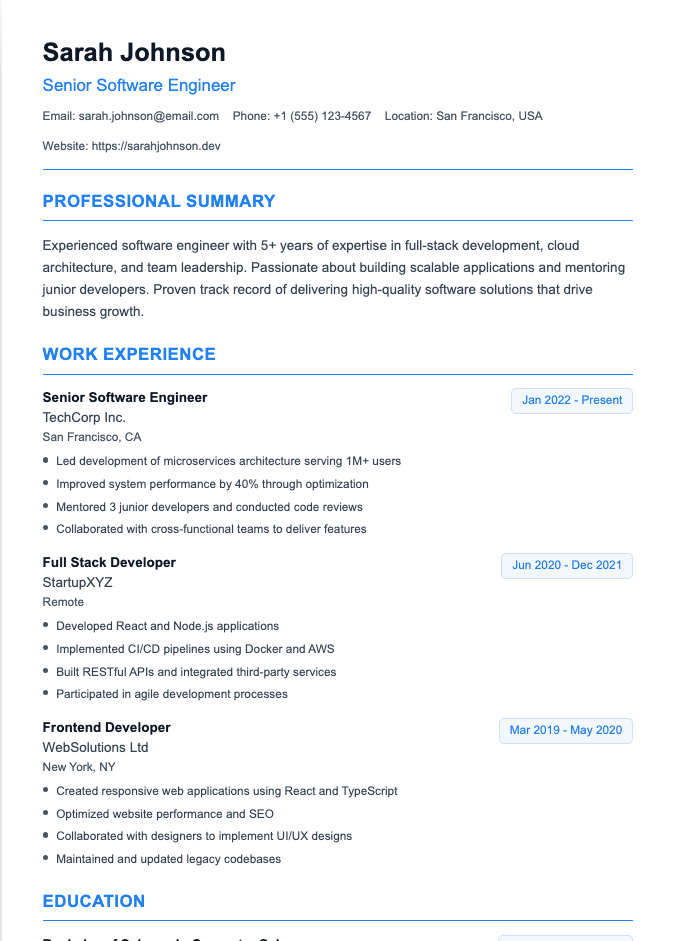
You can use this clean, ATS-friendly European CV template in Word, Google Docs, or our builder whenever an employer wants European conventions without the clunky multi-page Europass table layout:
[FIRST LAST NAME]
[City, Country] • [+Country Code Phone] • [Professional Email] • [LinkedIn URL]ABOUT ME
[2–3 concise sentences tailored to the vacancy notice, e.g., Multilingual Product Operations Manager with 5+ years of experience scaling B2B SaaS onboarding across DACH and Benelux markets. Proven track record of reducing customer time-to-value by 30% using SQL, Jira, and automated CRM workflows.]WORK EXPERIENCE
[Job Title] — [Company Name], [City, Country] ([MM/YYYY] – Present)
- [Action verb + scope + quantified result, e.g., Managed cross-border rollout of enterprise billing portal across 6 EU markets, increasing self-serve renewals by 22%]
- [Coordinated 14-person product and support squad using Agile Scrum, cutting ticket escalation resolution time from 48h to 14h]
- [Authored onboarding documentation in English and German, improving new-hire ramp speed by 3 weeks]
[Previous Job Title] — [Company Name], [City, Country] ([MM/YYYY] – [MM/YYYY])
- [Action verb + project + measurable impact]
- [Action verb + process or revenue outcome]
EDUCATION AND TRAINING
M.Sc. in International Business & Economics (EQF Level 7)
[University Name], [City, Country] ([YYYY] – [YYYY])
- Thesis / Focus: [Brief topic if relevant]
B.A. in Business Administration (EQF Level 6)
[University Name], [City, Country] ([YYYY] – [YYYY])LANGUAGE SKILLS
- Mother tongue(s): [e.g., German]
- Other language(s):
- English: C1 (Proficient user — Listening C2, Reading C2, Speaking C1, Writing C1)
- French: B2 (Independent user)
DIGITAL & TECHNICAL SKILLS
- Data & Analytics: SQL, Python, Looker Studio, Advanced Excel
- Project & CRM Tools: Jira, Confluence, Salesforce, HubSpot, Notion
European CV vs. UK CV vs. US Resume: Key Differences
Applying across borders is much easier once you know the local ground rules:
- Length: A US resume is strictly 1 page for early-career candidates and 1–2 pages for experienced hires. A UK CV is typically 2 pages. A European or Europass CV is 1–2 pages (or 2–3 pages for academic and institutional roles).
- Photo norms: Never include a photo on a US or UK resume. In Germany, Austria, France, Spain, and Italy, a professional headshot is still common (though optional at many international tech firms). In the Netherlands, Sweden, Ireland, and the UK, leaving the photo off is generally preferred.
- Personal details: US and UK resumes include only your name, contact info, and city. Some European employers still recognize nationality or work-permit status (especially if you already hold EU work authorization), which can be a helpful one-line note when applying from abroad.
- Language ratings: US resumes rarely use standardized scales; European CVs almost always expect CEFR (A1–C2) levels.
5 Official Tips for Writing a Strong European CV
Based on the official Europass guidelines and European recruiter best practices:
- Match the vacancy notice: Mirror the exact skills and qualifications requested in the job posting so both human recruiters and ATS filters see the fit immediately.
- Tailor the "About Me" section every time: Skip generic clichés ("hardworking team player") and state your core role, years of experience, and top achievement.
- Use strong action verbs and numbers: Start bullets with verbs like Managed, Developed, Increased, or Streamlined and back them up with percentages, revenue, or time saved (see our guide to resume bullet points).
- Keep it to 1–2 pages: The Europass online builder loves adding wide margins and page breaks that turn a one-page career into a four-page novel. Trim older or irrelevant details so your best work stays on page one.
- Double-check language and spelling: If you generate your CV in English for a multinational role in Berlin or Amsterdam, proofread carefully so awkward literal translations don't undercut your C1 English rating.
Frequently Asked Questions
Is the Europass CV free to use?
Yes. The official Europass platform (europass.europa.eu), managed by the European Union, is completely free. You can create a Europass profile, generate CVs and cover letters in 31 languages, and download PDFs without paying any subscription fee.
Is a Europass CV mandatory in Europe?
No. A Europass CV is only mandatory if an employer, university, or EU institution explicitly asks for it in the application instructions. For most private-sector jobs in Europe, a modern, tailored 1–2 page CV is preferred.
Should I put a photo on my European CV?
It depends on the country. In Germany, France, Spain, and Austria, a professional headshot is still common, though increasingly optional. In the UK, Ireland, the Netherlands, and Scandinavia, you should generally omit your photo unless requested.
How do I list language skills on a European CV?
List your native language ("Mother tongue") first, then rate your other languages using the six-level CEFR scale: A1 and A2 for basic users, B1 and B2 for independent working users, and C1 and C2 for proficient users.
Is the Europass CV ATS-friendly?
Standard Europass PDF exports can sometimes struggle with older corporate applicant tracking systems because of their multi-column sidebars, icons, and skill tables. If you are applying through a corporate job portal and Europass isn't strictly required, a clean single-column CV is safer.
What is the difference between a European CV and a US resume?
A European CV often runs two pages, uses CEFR language levels (A1–C2), and may include a photo or nationality depending on country norms. A US resume is typically one to two pages, strictly omits photos and personal demographics, and focuses heavily on quantified business results.
Build a Modern European-Ready CV in Minutes
Applying to international or private-sector roles across Europe and want a layout that looks sharper than a default government form? Use our Resume Builder to create a clean, ATS-friendly CV that highlights your experience, languages, and results.