

Quick answer: What is biodata? Biodata is short for "biographical data": a document summarizing your personal details, education, work history, and skills. It's most common in South Asian countries such as India, Pakistan, Bangladesh, and Nepal, where it's used for government jobs, some private jobs, and marriage proposals. It includes more personal information than a resume.
If an employer asked for your "biodata" and you thought, "Is that a resume with extra steps?", you're not far off.
Biodata, resume, and CV all describe you on paper, but they're built for different readers and different places. This guide explains what biodata is, what goes in it, a fill-in biodata format, and how it compares to a resume and CV.
What Is Biodata?
Biodata stands for biographical data. In everyday job-hunting terms, it's a document that lists your personal information alongside your qualifications and experience.
The term is used in two main ways:
- In South Asia, biodata is essentially a resume or CV, used for jobs, grants, and marriage. It often includes details a Western resume would leave out, like date of birth, religion, nationality, marital status, and sometimes a photo or height.
- In industrial and organizational psychology, "biodata" means structured questions about your past life and work experiences, used in hiring to predict future behavior. The idea behind it: past behavior is a good predictor of future behavior.
Most people searching for biodata mean the first one, so that's what the rest of this guide covers.
Where biodata is used
- Government and public-sector jobs, which often specify a biodata format in the official notification
- Some private-sector jobs, mostly in traditional industries or smaller companies
- Marriage proposals, where a marriage biodata introduces a person and their family
- Academic and grant applications in some institutions
Corporate recruiters and multinational companies usually expect a resume instead.
Types of Biodata
- Job biodata: your professional profile plus personal details
- Marriage biodata: personal and family background, hobbies, and expectations for a partner
- Educational biodata: for school, college, or scholarship applications
- Medical biodata: health-related personal information
What to Include in a Biodata for a Job
A job biodata usually follows a simple, chronological structure.
1. Photo (optional)
A recent, professional photo. Some employers require it; many don't. Check the job notice.
2. Personal details
Full name, date of birth, gender, marital status, nationality, languages known, address, phone number, and email. Some formats also ask for father's name and religion. Only include what's requested.
3. Career objective
One or two sentences on the role you want and what you bring. Keep it specific.
4. Educational qualifications
Degree or exam, institution, board or university, year of passing, and grade or percentage.
5. Work experience
Company, designation, duration, and key responsibilities or achievements.
6. Skills
A balance of technical and soft skills that match the role.
7. Hobbies and interests
Brief and genuine. "Reading" is fine; "competitive napping" probably isn't, even if you're very good at it.
8. Declaration
A short statement that the information is true, followed by place, date, and signature.

Biodata Format (Fill-in Template)
Copy this and replace the brackets with your details:
BIODATA
[Attach photo, if requested]Personal Details
Name: [Full name]
Date of Birth: [DD/MM/YYYY]
Gender: [Gender]
Marital Status: [Single / Married]
Nationality: [Nationality]
Languages Known: [Languages]
Address: [Full address]
Phone: [Number]
Email: [Professional email]Career Objective
[One or two sentences: the role you want and what you offer.]Educational Qualifications
[Degree], [Institution], [University/Board], [Year], [Grade/Percentage]
[Higher Secondary], [School], [Board], [Year], [Percentage]Work Experience
[Designation], [Company], [Month Year] – [Month Year]
- [Key responsibility or achievement]
- [Key responsibility or achievement]
Skills
[Skill 1], [Skill 2], [Skill 3], [Skill 4]Hobbies
[Hobby 1], [Hobby 2]Declaration
I hereby declare that the information given above is true to the best of my knowledge.
Place: [City]
Date: [Date]
Signature: [Your name]
Keep a job biodata to one or two pages. If the employer provides its own format, use theirs exactly.
Biodata vs Resume vs CV
All three describe you, but they emphasize different things.
Biodata
- Focus: personal details plus education and experience
- Length: usually one to two pages
- Order: chronological, starting with personal details
- Used for: government jobs, traditional employers, and marriage, mostly in South Asia
Resume
- Focus: skills and achievements relevant to one specific job
- Length: usually one to two pages (here's how long a resume should be)
- Order: usually reverse-chronological
- Personal details like age, religion, or marital status are left out
- Used for: most private-sector jobs, especially in the US, Canada, and corporate roles worldwide
CV (curriculum vitae)
- Focus: a full record of your education, research, publications, and experience
- Length: often several pages, with no strict limit
- Used for: academic, research, and medical roles, and as a general term for "resume" in the UK and much of Europe and Asia
Which one should you send?
Send exactly what the job posting asks for. When in doubt:
- Government or traditional employer in South Asia? Biodata, in their format.
- Private company or multinational? A tailored resume.
- Academic or research role? A CV. Our academic CV template can help.
- Applying in Europe? Check whether they want a Europass CV.
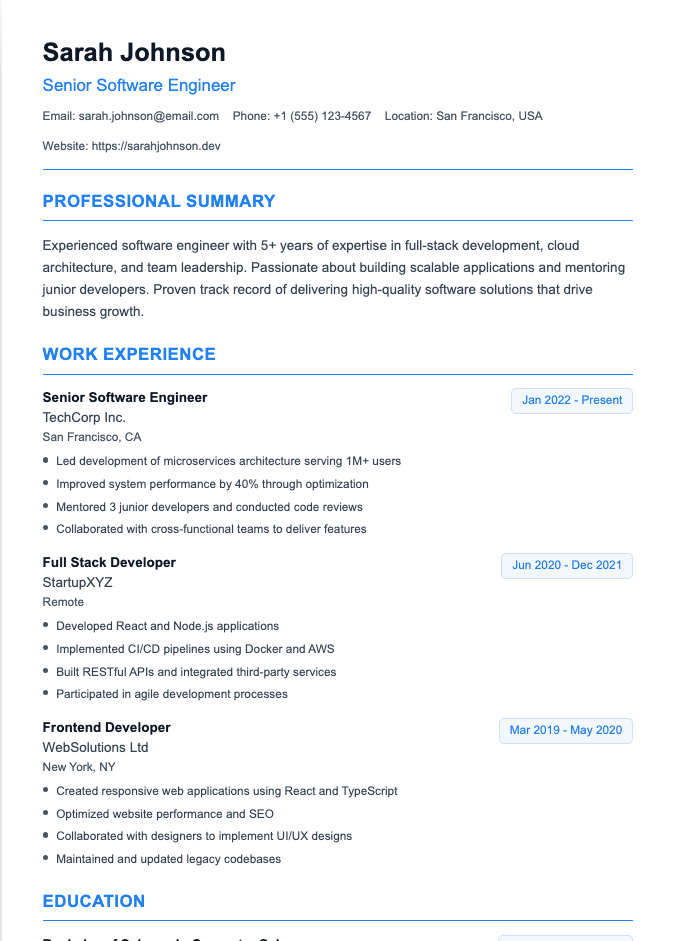
Tips for Writing a Strong Biodata
- Read the job notification first. Many public-sector jobs specify the exact format.
- Never falsify anything. A wrong date or exaggerated qualification can disqualify you.
- Keep it clean and simple. Clear headings, consistent dates, no decorative fonts.
- Share only what's needed. Leave out sensitive details the employer hasn't asked for.
- Proofread twice. Then ask someone else to proofread it, because you'll read what you meant to write.
Frequently Asked Questions
What is the full form of biodata?
Biodata is short for "biographical data." It refers to a document that summarizes your personal details, education, and work history.
Is biodata the same as a resume?
Not exactly. They overlap, but biodata puts more weight on personal details like date of birth, marital status, and nationality, while a resume focuses on skills and achievements for a specific job.
What is the difference between biodata, resume, and CV?
Biodata emphasizes personal information, a resume is a short, tailored summary of relevant experience, and a CV is a detailed, often multi-page record of your full academic and professional history.
Should I put a photo on my biodata?
Only if the employer or format asks for one. For marriage biodata, a photo is usually expected. For jobs, it's often optional.
Can I use biodata for jobs in the US or UK?
Generally, no. Employers in the US and UK expect a resume or CV, and they usually prefer you leave out personal details like age, religion, and marital status.
How long should a biodata be?
A job biodata is typically one to two pages. Keep it concise and follow any length limit in the job notice.
Need a Resume Instead?
If the job calls for a resume rather than a biodata, our Resume Builder helps you turn the same details into a clean, ATS-friendly resume in minutes.