

Quick answer: A Singapore resume is usually a 1–2 page, reverse-chronological PDF on A4 paper, written in British English, with your contact details, work pass or citizenship status, a short summary, work experience, education, skills, and languages. Leave out your NRIC number, age, religion, and marital status. Singapore business letters (cover letters, offer acceptances, formal correspondence) follow the British block format: date written as 24 October 2026, a formal salutation, short paragraphs, and "Yours sincerely" or "Yours faithfully" to sign off.
Below you'll find a free copy-paste Singapore resume template, three business letter templates, and every local rule that trips up job seekers.
Why Singapore Resumes Are Different
Singapore is a small island with a very large number of people applying for the same job. Recruiters here are fast, formal, and efficient, and many companies run applications through an Applicant Tracking System (ATS) before a human ever sees them. (If ATS is new to you, read the truth about ATS first.)
On top of the usual resume rules, Singapore has a few local quirks:
- Work pass status matters. Employers hiring foreigners deal with quotas, levies, and the COMPASS points framework for Employment Pass applications, so they want to know your status up front.
- Salary comes up early. Many application forms ask for your expected and last-drawn salary, quoted in SGD per month.
- Notice periods are long. One to three months is common, so hiring managers want to know when you can actually start.
- Spelling is British. "Organised," not "organized." "Programme," not "program" (unless you're writing code).
Think of a Singapore resume like a good plate of chicken rice: simple on the surface, but everyone has strong opinions about how it should be done.
The 3 Resume Formats Used in Singapore

1. Reverse-Chronological (the default)
Lists your most recent job first and works backwards. This is what most Singapore recruiters expect and what ATS software reads most reliably. Use it if you have a steady work history in the same field.
2. Functional (skills-based)
Groups your experience by skill instead of by employer. It can hide employment gaps, but recruiters know that, and some ATS systems struggle with it. Use it sparingly, mainly if you are making a dramatic career switch.
3. Combination (hybrid)
Opens with a strong skills section, then follows with a reverse-chronological work history. Use it if you're changing careers or returning after a break. Our guide on selling transferable skills shows how to do this well.
Our recommendation: Go reverse-chronological unless you have a specific reason not to. It's the "kopi-o kosong" of resume formats: no surprises, and nobody complains.
Free Singapore Resume Template (Copy & Paste)
Copy this structure into Word, Google Docs, or our Resume Builder. Replace everything in brackets.
[FULL NAME]
[Job Title You're Targeting]
[+65 9XXX XXXX] · [email@domain.com] · [linkedin.com/in/yourname] · [Area, Singapore]
[Singapore Citizen / Permanent Resident / Employment Pass Holder] · Notice period: [1 month] · Available from: [Date]PROFESSIONAL SUMMARY
[Job title] with [X] years of experience in [industry]. Known for [key strength] and [measurable achievement, e.g. "cut reporting time by 40%"]. Looking to bring [skill] to [type of role].WORK EXPERIENCE
[Job Title] | [Company Name], Singapore | [Mon YYYY] – Present
- [Action verb] + [what you did] + [result with a number]
- [Action verb] + [what you did] + [result with a number]
- [Action verb] + [what you did] + [result with a number]
[Job Title] | [Company Name] | [Mon YYYY] – [Mon YYYY]
- [Achievement]
- [Achievement]
EDUCATION
[Degree], [Major] | [University] | [Year]
[Diploma / A-Levels, if relevant and you're early in your career]SKILLS
[Skill 1] · [Skill 2] · [Skill 3] · [Software / Tools] · [Certifications]LANGUAGES
English (Native / Professional) · Mandarin (Conversational) · [Malay / Tamil / Other]EXPECTED SALARY (optional – only if the job ad asks)
SGD [X,XXX] per month, negotiable
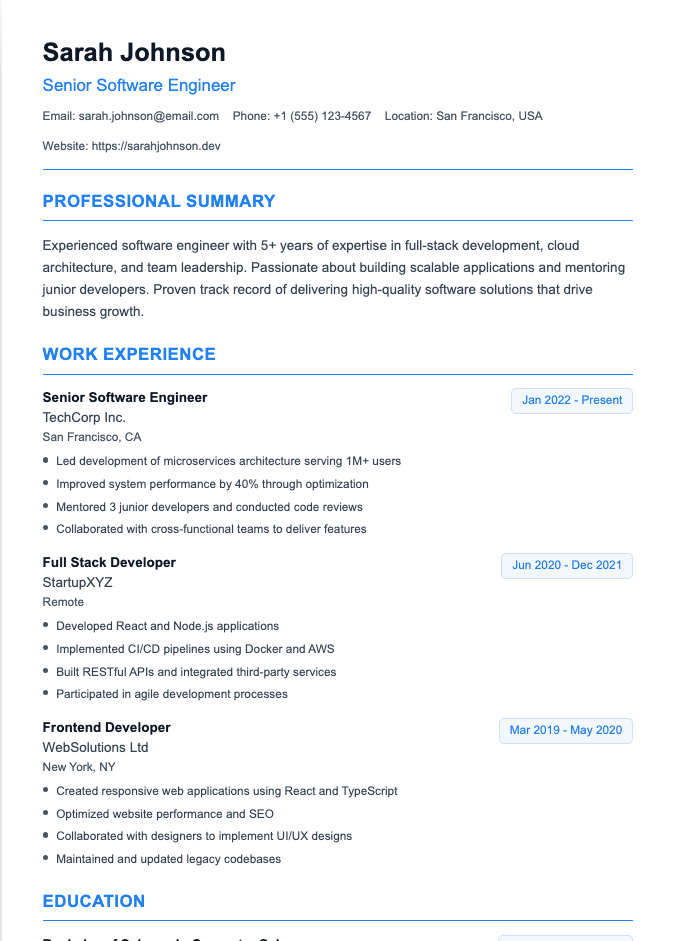
Need help with the bullets? Turn "responsible for" into real results with our guide to resume bullet points, and nail the top section with how to write a resume summary.
Singapore Resume Format Rules: Length, Fonts, and Layout
- Length: One page if you have under 5 years of experience. Two pages is normal for mid-career professionals. Senior executives sometimes go longer, but every extra page should earn its keep.
- Paper size: A4, not US Letter. Your margins will look strange if you mix them up.
- Fonts: A clean sans-serif like Arial or Calibri, 10–12pt for body text, 14–16pt for your name.
- Margins: About 2–2.5cm (roughly 1 inch) all round.
- File type: PDF, unless the job portal specifically asks for Word. Name it properly: Tan_WeiLing_Resume.pdf, not resume_final_FINAL_v3.pdf.
- Layout: Avoid tables, text boxes, icons, and skill "progress bars." They look nice and confuse ATS. A plain, keyword-optimised resume beats a pretty one that can't be parsed.
Should You Include a Photo?
It's optional. A professional headshot is still common in Singapore, especially for client-facing, hospitality, and some public sector roles. For tech, finance, and multinational companies, most candidates skip it. If you do include one, make it a recent, well-lit headshot with a plain background. Not a wedding photo. Not a cropped group photo with a mysterious extra shoulder.
What to Leave Off Your Singapore Resume
This is the part many templates get wrong, so here is the serious bit. (Switches to serious face.)
- Your NRIC number. Under the PDPC's advisory guidelines (in effect since September 2019), organisations generally shouldn't collect full NRIC numbers unless it's legally required or necessary to verify identity. A recruiter doesn't need it to read your resume, and putting it on a document you email to strangers is a data-protection risk.
- Age, date of birth, race, religion, and marital status. Singapore's fair employment guidelines (TAFEP) discourage employers from asking for personal details that aren't relevant to the job. Leave them out.
- Full home address. Your area or postal district is enough (e.g. "Tampines, Singapore").
- References. Write nothing, or "Available upon request." Never list your referees' phone numbers on the resume itself.
- Last-drawn salary. You don't have to volunteer it. If a form forces the question, you can answer with your expected salary range instead.
Singapore Business Letter Format

This section is the part most "Singapore resume" guides skip entirely. Your resume gets you noticed, but job hunting also involves letters: cover letters, offer acceptances, reference requests, and resignations. Singapore follows British business-letter conventions:
- Block format: Everything left-aligned, with a blank line between paragraphs.
- Date format: 24 October 2026 (day, month, year). Never 10/24/2026. In Singapore, that reads as the 10th day of the 24th month, a month nobody has discovered yet.
- Salutation: "Dear Mr Lim" or "Dear Ms Tan" (no full stop after Mr/Ms in British style). If you don't know the name, "Dear Hiring Manager" or "Dear Sir/Madam."
- Sign-off: "Yours sincerely" if you used their name. "Yours faithfully" if you wrote "Dear Sir/Madam."
- Font and spacing: Match your resume. Same font, 11–12pt, single-spaced, one page maximum.
3 Free Singapore Business Letter Templates
Template 1: Cover Letter (Singapore Format)
[Your Name]
[+65 9XXX XXXX] · [email@domain.com][24 October 2026]
[Hiring Manager's Name]
[Company Name]
[Company Address]
Singapore [Postal Code]Dear [Mr/Ms Surname],
Application for the Position of [Job Title] (Ref: [Job ID])
I am writing to apply for the [Job Title] role advertised on [MyCareersFuture / LinkedIn / company website]. With [X] years of experience in [field] and a track record of [key achievement], I am confident I can contribute to [Company Name]'s [specific goal or project].
In my current role at [Company], I [specific achievement with a number]. I have also [second relevant achievement], which aligns closely with your need for [requirement from the job ad].
I am a [Singapore Citizen / PR / EP holder] with a notice period of [one month]. I would welcome the opportunity to discuss how I can support your team.
Thank you for your time and consideration.
Yours sincerely,
[Your Name]
Want the full playbook? Read our guide on how to write a cover letter.
Template 2: Job Offer Acceptance Letter
[24 October 2026]
Dear [Mr/Ms Surname],
Acceptance of Offer – [Job Title]
Thank you for offering me the position of [Job Title] at [Company Name]. I am pleased to formally accept the offer as outlined in your letter dated [Date].
I confirm my monthly salary of SGD [X,XXX] and my start date of [Date], following the completion of my [one-month] notice period with my current employer.
Please let me know if there are any documents I should prepare before my first day. I look forward to joining the team.
Yours sincerely,
[Your Name]
Template 3: General Formal Business Letter
Use this for reference requests, formal enquiries, or follow-ups with an organisation.
[Your Name]
[Your Address / Email][24 October 2026]
[Recipient Name]
[Title]
[Organisation]
[Address]
Singapore [Postal Code]Dear [Mr/Ms Surname / Sir or Madam],
Re: [Subject of Letter]
[Paragraph 1: State the purpose of your letter in one or two sentences.]
[Paragraph 2: Provide the necessary details, context, or request.]
[Paragraph 3: State the next step you're asking for and any deadline.]
Thank you for your attention to this matter.
Yours sincerely / Yours faithfully,
[Your Name]
[Designation, if applicable]
Leaving your current job? Grab one of our resignation letter templates. They work perfectly in Singapore. Just switch the date to day-month-year format and give the notice period stated in your contract, not the standard US "two weeks."
Tips for Writing a Resume That Gets Shortlisted in Singapore
- Tailor it every time. Mirror the exact wording of the job ad, especially skills and job titles.
- Quantify everything. "Managed a team" is fine. "Managed a team of 8 across Singapore and Malaysia, cutting turnaround time by 30%" gets you an interview.
- Use the STAR method for bullets and interviews alike. See our STAR method guide.
- Stay consistent. Pick British English and stick to it. A resume that says "organised" in one line and "organized" in the next is like an MRT door chime that plays half the tune.
- Proofread out loud. Spellcheck won't flag "Project Manger" because "manger" is a real word. Unless the role involves a nativity scene, you'll want that "a" back.
Bonus: Using AI to Localise Your Resume for Singapore
If you've built your resume for another market (US, UK, India, or Australia), you don't need to start over. Upload it to our AI Resume Builder and ask it to:
- Convert American spelling to British spelling
- Add a work pass / availability line to your header
- Strip out personal details Singapore employers shouldn't be collecting
- Rewrite your bullets around measurable results
It's quicker than redoing it by hand, and the AI doesn't need a teh tarik break halfway through.
Frequently Asked Questions
What is the best resume format for Singapore?
The reverse-chronological format is the best choice for most Singapore job seekers. It is what recruiters expect and what ATS software reads most reliably. Use a combination format if you're changing careers.
How long should a resume be in Singapore?
One page for fresh graduates and early-career professionals, and up to two pages for mid-career candidates. Senior executives may go slightly longer, but only if every section is relevant.
Should I include a photo on my resume in Singapore?
It's optional. Photos are still common for client-facing, hospitality, and some government roles, but most tech, finance, and MNC applicants leave them out. If you include one, use a professional headshot.
Should I put my NRIC number on my resume?
No. Under Singapore's PDPA guidelines, organisations generally shouldn't collect full NRIC numbers at the application stage. You'll provide identification later, during onboarding, if it's legally required.
Should I include my nationality or work pass status?
Yes. A short line such as "Singapore Citizen," "Permanent Resident," or "Employment Pass Holder" saves recruiters time and can move you up the shortlist.
Should I include my expected salary on my resume?
Only if the job ad asks for it. If you include it, state a monthly figure in SGD and add "negotiable."
What is the difference between a CV and a cover letter?
A CV (or resume) is a factual summary of your experience, education, and skills. A cover letter is a one-page letter that explains why you want this particular job and why you're a good fit. In Singapore, "CV" and "resume" are used interchangeably.
Should I include references on my resume?
No. Write "Available upon request" or leave it out entirely. Share referee details only when the employer asks, usually at the final interview or offer stage.
Ready to Build Your Singapore Resume?
Templates are a great starting point. A resume tailored to each job is what actually gets you hired.
Use our AI Resume Builder to create an ATS-friendly, Singapore-ready resume in minutes, then pair it with one of the letter templates above. Your future self (and your future manager) will thank you.