

Quick answer: The best 1 page resume examples share a single-column layout, a 2–3 line summary, 3–5 results-focused bullets per recent role, a targeted skills section, and brief education. One page is ideal if you have under roughly 10 years of relevant experience, are a student, or are changing careers. Cut old or irrelevant details before shrinking fonts.
Fitting your whole career onto one sheet of paper feels a bit like packing for a two-week trip with a carry-on. Painful at first, but you quickly discover you did not need four pairs of shoes (or that 2014 internship bullet about "filing").
Below you will find 1 page resume examples for different career stages, the one page resume format that works best, a fill-in one page resume template, and practical tricks for making everything fit without making it unreadable.
Should Your Resume Be One Page?
For most job seekers, yes. Recruiters skim quickly; resume.co cites a TheLadders eye-tracking study finding recruiters spend about 7.4 seconds on an initial scan. A tight one-page resume puts your best evidence where that quick glance lands.
One page is usually right if you:
- Have under about 10 years of relevant experience
- Are a student, recent graduate, or entry-level candidate
- Are changing careers and only part of your history is relevant
- Are applying to a role or company that explicitly asks for one page
Two pages can make sense if you:
- Have 10+ years of directly relevant experience
- Are applying for senior, executive, or highly technical roles
- Work in fields where detail is expected (for example, some healthcare, government, or engineering roles)
- Are applying for academic or research positions, where a longer CV is the norm
The deciding question is not "How many years have I worked?" but "Is every line relevant to this job?" If cutting to one page means deleting achievements the hiring manager needs to see, use two full pages. Never stretch to two pages with filler, and never cram two pages of content onto one with tiny fonts.
The Best Resume Format for One Page
The one page resume format that works for most people is the reverse-chronological format: your most recent role first, working backward. It is the format recruiters expect and the one ATS software reads most reliably. (We break it down fully in our guide to the reverse-chronological resume.)
Recommended section order
- Header: Name, phone, professional email, city/state, LinkedIn or portfolio.
- Summary (2–3 lines): Who you are, what you do best, and what you are targeting.
- Work Experience: 3–5 bullets for recent roles, 1–3 for older ones.
- Skills: A targeted list of hard skills and tools that match the job posting.
- Education: Degree, school, graduation year (add GPA, honors, or coursework only if early-career).
- Optional: Certifications, projects, or volunteer work, but only if they earn their space.
Students and career changers can move Education or Projects above Experience when those sections are stronger.
Layout settings that keep it readable
- Single column. It is easier to scan and safer for applicant tracking systems than two-column designs.
- Font size 10–12 pt for body text, slightly larger for your name and headings.
- Margins between 0.5 and 1 inch. One inch is standard; going below half an inch starts to look cramped.
- Bullets, not paragraphs. Each bullet should be one or two lines.
- Consistent spacing between sections so the eye can jump around easily.
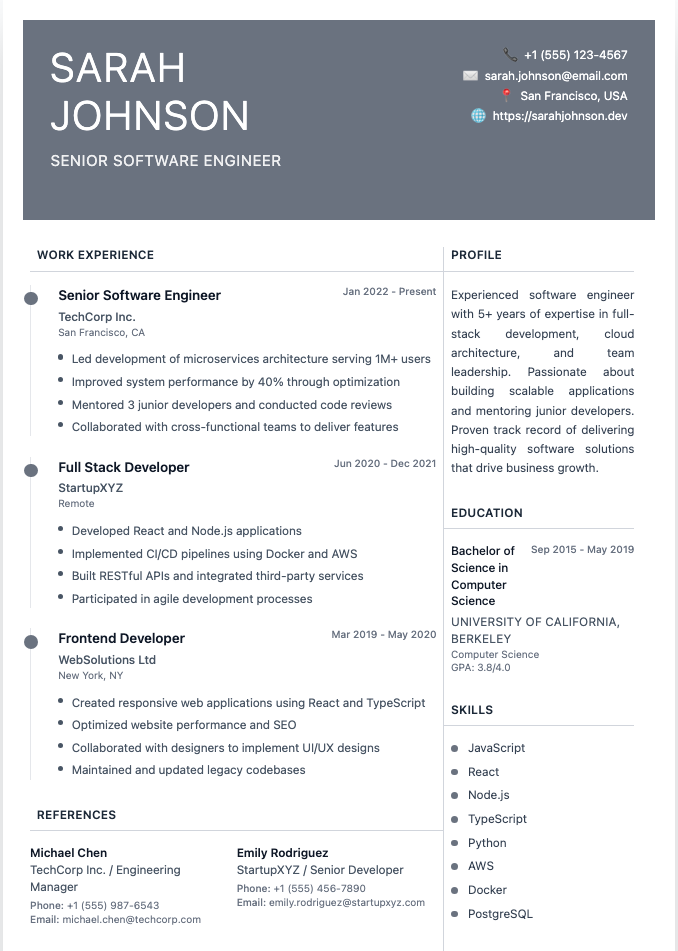
1 Page Resume Examples by Career Stage
Here are short, realistic examples you can adapt. Each one is written to fit on a single page with standard formatting.
Example 1: Student / internship resume
Maya Patel
Austin, TX · maya.patel@email.com · (555) 123-4567 · linkedin.com/in/mayapatelSummary
Junior marketing student with hands-on social media and event experience. Seeking a summer marketing internship to apply content strategy and analytics skills.Education
B.B.A. Marketing, University of Texas at Austin, Expected May 2027
Relevant coursework: Consumer Behavior, Digital Marketing, Marketing AnalyticsExperience
Social Media Coordinator, Student Marketing Association, Aug 2025 – Present
- Plan and publish weekly content across Instagram and TikTok
- Grew event attendance by promoting workshops with short-form video
- Coordinate with a 6-person events team on campaign timelines
Barista, Local Coffee Co., Jun 2024 – Present
- Handle high-volume morning rush while keeping order accuracy high
- Trained 4 new team members on point-of-sale and opening procedures
Skills
Canva, Google Analytics, Meta Business Suite, Excel, copywriting, public speaking
If you are starting from scratch, our guide on how to write a resume with no experience shows how to fill this page with projects and coursework.
Example 2: Entry-level / first full-time job
Jordan Lee
Chicago, IL · jordan.lee@email.com · (555) 987-6543Summary
Detail-oriented business graduate with internship experience in operations and data reporting. Skilled in Excel and SQL, looking to grow as an Operations Analyst.Experience
Operations Intern, Midwest Logistics, May 2025 – Aug 2025
- Built a weekly shipment dashboard in Excel used by 3 regional managers
- Reduced manual data entry by automating a recurring report with formulas
- Documented warehouse intake process for new-hire onboarding
Sales Associate, Retail Store, 2022 – 2025
- Consistently met weekly sales targets during peak seasons
- Resolved customer issues and processed returns accurately
Education
B.S. Business Administration, Illinois State University, 2025Skills
Excel (pivot tables, XLOOKUP), SQL, Tableau, process documentation
Example 3: Mid-career professional (5–8 years)
Alex Romero
Denver, CO · alex.romero@email.com · linkedin.com/in/alexromeroSummary
Project manager with 7 years of experience delivering software and infrastructure projects on time and on budget. PMP certified; known for clear stakeholder communication.Experience
Senior Project Manager, CloudTech Solutions, 2022 – Present
- Lead cross-functional teams of 8–12 across engineering, design, and QA
- Delivered a platform migration two weeks ahead of schedule
- Introduced a risk log that cut late-stage scope changes
- Manage project budgets and report status to executive sponsors
Project Coordinator → Project Manager, Brightline Systems, 2018 – 2022
- Promoted after 18 months for consistently on-time delivery
- Coordinated vendor contracts and timelines for 15+ client projects
- Rolled out Jira workflows across 3 delivery teams
Education & Certifications
B.S. Information Systems, University of Colorado · PMPSkills
Agile/Scrum, Jira, budgeting, risk management, stakeholder reporting
Example 4: Career changer
Sam Okafor
Atlanta, GA · sam.okafor@email.com · portfolio.example.comSummary
Former high school teacher transitioning into instructional design. Six years of creating engaging curricula, plus a recent certificate in e-learning development.Relevant Projects
Onboarding Course Redesign (volunteer, nonprofit client)
- Built a 5-module e-learning course in Articulate Rise
- Wrote scripts and quizzes aligned to learning objectives
Experience
Science Teacher, Atlanta Public Schools, 2019 – 2025
- Designed lesson plans and assessments for 150+ students per year
- Led professional development sessions for colleagues on digital tools
Education & Training
Instructional Design Certificate, 2025 · B.S. Biology, Georgia State UniversitySkills
Articulate Rise/Storyline, ADDIE model, Canva, LMS administration, storyboarding
Want more help translating old experience into a new field? See our career change resume guide.
One Page Resume Template (Copy and Fill In)
Use this skeleton as your one page resume template. Delete any section you do not need.
[Full Name]
[City, State] · [Email] · [Phone] · [LinkedIn or Portfolio]Summary
[Job title or identity] with [X years / key background] in [specialty]. Known for [strength or result]. Seeking [target role].Experience
[Job Title], [Company], [City, State], [Start] – [End]
- [Action verb] + [what you did] + [result or scale]
- [Action verb] + [what you did] + [result or scale]
- [Action verb] + [what you did] + [result or scale]
[Job Title], [Company], [City, State], [Start] – [End]
- [Achievement]
- [Achievement]
Skills
[Skill], [Skill], [Tool], [Tool], [Certification]Education
[Degree], [School], [Year]
How to Fit Your Resume on One Page

Work through these steps in order. Content cuts come first; formatting tweaks come last.
1. Cut anything older than 10–15 years
Recruiters care most about recent, relevant work. Summarize or delete early-career roles unless they are directly related to the job.
2. Remove what does not earn its space
- "References available upon request" (recruiters already assume at least two people like you)
- Objective statements if you already have a summary
- Hobbies and interests, unless they are relevant to the role
- Personal details like date of birth or marital status (not expected in the US)
- Soft skills that are not backed up anywhere else on the page
3. Tighten every bullet
Drop pronouns and filler ("responsible for," "helped with"). Start with a strong verb and end with a result. Our guide on resume bullet points that turn duties into results has dozens of before-and-after examples.
Before: I was responsible for helping the team manage the company's social media accounts and posting content regularly.
After: Managed 3 company social accounts, publishing 5 posts per week.
4. Combine small sections
Fold certifications into Education, merge Tools into Skills, and put job title, company, and dates on one line.
5. Watch for "widow" lines
A bullet that wraps one or two words onto a new line wastes a whole row. Rephrase it to fit on one line.
6. Adjust formatting last
Only now should you nudge margins (not below 0.5 inch), drop the body font half a point, or tighten line spacing. If you need tiny text to make it fit, the content still needs editing.
Common One-Page Resume Mistakes
- Shrinking everything to 8 pt. If the reader needs a magnifying glass, you have traded one problem for another.
- Using two columns full of icons. It may look tidy, but some ATS tools scramble it. See the truth about ATS.
- Cutting your achievements instead of your duties. Keep the results; trim the routine tasks.
- One resume for every job. Tailor the summary, skills, and top bullets to each posting using resume keywords.
- Leaving a half-empty page. One page means a full page. If you have space, add a project or a stronger bullet.
Frequently Asked Questions
Is a one-page resume still the standard?
For early-career and mid-career candidates, one page remains the safest default. Many hiring managers prefer it because it is quick to scan. Experienced professionals with 10+ years of relevant work can use two pages if every line adds value.
How do I fit my resume on one page?
Start by cutting older and irrelevant roles, then tighten bullets so each is one line, and combine small sections. Adjust margins and font size only at the end. Keep body text at 10 pt or larger and margins at 0.5 inch or more.
Can a one-page resume have two columns?
It can, but a single-column layout is easier to read and more reliable with applicant tracking systems. If you use two columns, keep your experience in the main column and test the file in an ATS checker before applying.
Is a one-page resume better than a two-page resume?
Not automatically. A one-page resume is better when it holds everything relevant; a two-page resume is better when cutting would remove important achievements. Relevance matters more than length.
What should I leave off a one-page resume?
Leave off references, "references available upon request," outdated roles, unrelated hobbies, full street addresses, and personal details like age or marital status. Older jobs can be summarized in a short "Earlier Experience" line.
How many bullet points per job on a one-page resume?
Aim for 3–5 bullets for your most recent or most relevant roles and 1–3 for older positions. Each bullet should show an action and a result rather than a general duty.
What font size is best for a one-page resume?
Use 10–12 pt for body text and 14–16 pt for headings or your name. Choose a clean font like Calibri, Arial, Garamond, or Helvetica so it stays readable when printed or viewed on a screen.
Build Your One-Page Resume Faster
Getting everything onto one page is easier when the layout handles spacing for you. Our Resume Builder uses clean, ATS-friendly templates and AI suggestions to tighten your bullets, so you can focus on what to say rather than wrestling with margins.