

Quick answer: A resume objective is a 1–2 sentence statement at the top of your resume that says who you are, the specific role you want, and the value you'll bring to the employer. It works best for students, recent grads, career changers, and people relocating. Experienced candidates usually do better with a resume summary.
That's the whole idea. Most objectives fail anyway, because they read like a wish list ("seeking a challenging role with growth opportunities") instead of a pitch. Below: what to include, when to use one, a simple formula, and resume objective examples you can adapt.
What Is a Resume Objective?
A resume objective (also called a career objective or objective statement) is a short introduction placed right under your name and contact details. It tells the recruiter, in a few seconds, what job you're targeting and why you're a reasonable bet for it.
It's optional, and plenty of recruiters don't expect one. But a sharp, tailored objective can help you stand out when your experience alone doesn't explain why you're applying.
Resume objective vs. summary
The difference comes down to direction:
- Resume objective: looks forward. It focuses on the role you want and the skills you bring to it. Best when your experience is light or doesn't obviously match the job.
- Resume summary: looks back. It highlights years of experience, scope, and measurable achievements. Best when you have relevant experience to show off.
If you have three or more years in the same field, skip the objective and read our guide on how to write a resume summary instead.
Who Should Use an Objective for a Resume?
An objective earns its spot when it explains something your resume can't explain on its own:
- Students and recent graduates with little paid work history
- Career changers whose past titles don't match the new field (we have 25+ examples in our career change resume objective guide)
- People relocating who want to signal they're moving to the job's city
- Returning workers after an employment gap
- Internal or level-up moves, such as moving from part-time to full-time, or into a first management role
If none of these apply, a summary will almost always do more for you.
What to Include in a Resume Objective
Strong objectives share the same four building blocks:
- Who you are: your current title, degree, or experience level ("Recent marketing graduate," "Certified pharmacy technician")
- Your best 1–2 skills or achievements: ideally matching keywords from the job ad, with a number if you have one
- The exact role you want: name the job title, and the company if you can
- The value you'll add: what the employer gets, not what you get
Notice what's missing: "growth," "a challenging environment," and "an opportunity to develop my skills." The employer already knows you'd like a job. (That's why you sent the resume.)
How to Write a Resume Objective in 4 Steps
1. Pull keywords from the job description
Highlight the skills and tools mentioned more than once. Work one or two of them into your objective. This helps both the human reader and the applicant tracking system.
2. Use the formula
[Who you are] with [top skill or achievement], seeking a [job title] role at [company] to [value you'll deliver].
3. Keep it short
Aim for one to two sentences, roughly 30–50 words. Recruiters skim the top third of a resume fast; an objective that runs five lines gets skipped.
4. Tailor it for every application
A generic objective is worse than no objective. Swap the job title, company name, and lead skill every time you apply. It takes two minutes and is the single biggest upgrade you can make.
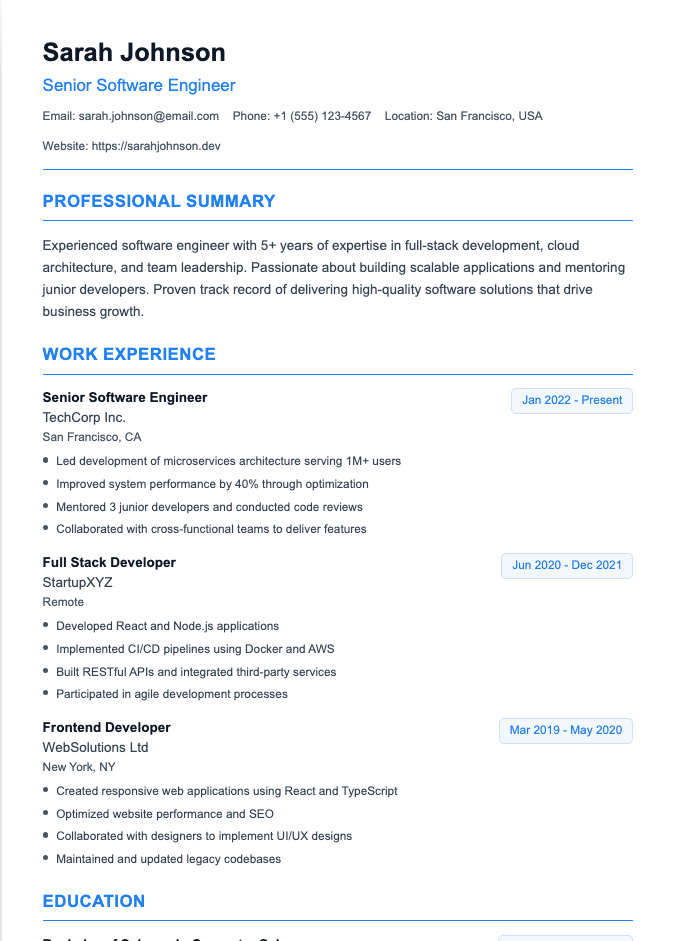
Resume Objective Examples
Adapt these resume objective examples by swapping in your own details and the employer's keywords.
No work experience
Dependable high school graduate with strong organization skills and two years of volunteer event coordination, seeking a front desk associate role at Brightside Fitness to keep check-ins fast and members happy.
Recent graduate
Recent B.S. in Accounting graduate with internship experience reconciling 200+ monthly transactions in QuickBooks, seeking a staff accountant position at Harbor & Co. to support accurate, on-time month-end closes.
Internship
Second-year computer science student skilled in Python and SQL, with two shipped class projects on GitHub, seeking a summer software engineering internship at Lumen Labs to help build and test data tools.
Career change
Former retail store manager with 6 years of hiring, scheduling, and training teams of 20+, transitioning into HR and seeking a recruiting coordinator role to bring a people-first, organized approach to high-volume hiring.
Relocation
Registered nurse with 4 years of med-surg experience relocating to Denver in June, seeking a full-time RN position at Mountain View Hospital to deliver safe, compassionate patient care from day one.
Promotion or next step
Customer support specialist with 3 years of experience and a 96% satisfaction score, seeking a team lead role to coach new agents and improve first-contact resolution.
Weak vs. strong
Weak: Hardworking individual seeking a position where I can grow my skills and advance my career.
Strong: Bilingual (English/Spanish) customer service rep with 2 years of call center experience, seeking a client success associate role at Vela to reduce churn through fast, friendly support.
The weak version could belong to anyone. The strong one could only belong to you.
Resume Goals: How to Show Career Goals on a Resume
Many people search for "resume goals" when they mean the career goal statement at the top of a resume. That's your objective. The trick is to frame your goal around what you'll contribute, not just what you want.
Short-term vs. long-term career goals
- Short-term goals (the next 6–24 months) belong on your resume: landing a specific role, applying a new skill, earning a certification, or moving into a new field
- Long-term goals (5–10 years) usually belong in your cover letter or interview, not your resume: becoming a manager, specializing, or starting a practice
How to turn a goal into a resume objective
Use this pattern: goal + skills you bring + how the employer benefits.
Weak goal: "My goal is to grow my career in marketing."
Strong resume goal: "Marketing graduate with HubSpot and Google Analytics certifications, aiming to grow organic traffic as a content marketing associate at BrightPath."
Resume goals examples by situation
- Entry-level: "Recent nursing graduate aiming to begin my career on a med-surg unit, bringing 600 clinical hours and BLS/ACLS certification."
- Career change: "Former teacher transitioning to instructional design, aiming to turn 8 years of curriculum experience into engaging e-learning for corporate teams."
- Promotion: "Senior customer support specialist ready to step into a team lead role, using 4 years of training and QA experience to raise team CSAT."
- Upskilling: "Data entry specialist aiming to grow into a data analyst role, applying new SQL and Tableau skills to improve reporting accuracy."
- Returning to work: "Administrative professional returning after a career break, aiming to bring strong scheduling and bookkeeping skills to a fast-paced office."
- Relocation: "Registered nurse relocating to Denver in March, aiming to join an ICU team and bring 5 years of critical care experience."
Where to talk about career goals beyond the resume
- Cover letter: explain why this role fits your long-term direction. See how to write a cover letter
- Interview: prepare a short answer to "Where do you see yourself in five years?" See common interview questions
- LinkedIn: your About section can share bigger goals. See LinkedIn headline examples
Common Resume Objective Mistakes
- Making it about you. "To gain experience" tells the employer what they give, not what they get.
- Being vague. "Results-driven team player" is filler. Use a skill, tool, or number.
- Using the same objective for every job. Recruiters can smell copy-paste.
- Writing a paragraph. Long objectives belong in your cover letter.
- Contradicting the job. If the ad says full-time onsite, don't write "seeking a remote part-time role."
Where Does a Resume Objective Go?
Put it directly below your resume heading, above your education or experience. Label it "Objective" or "Career Objective," or leave the label off.
Frequently Asked Questions
Is a resume objective still necessary in 2026?
No, it's optional. Most experienced candidates are better off with a summary. But for entry-level applicants, career changers, and people relocating, a tailored objective still adds useful context.
How long should a resume objective be?
One to two sentences, roughly 30–50 words. If it spills past three lines, cut the adjectives first.
What is a good objective for a resume with no experience?
Lead with your strongest transferable skills (organization, customer service, reliability) and anything concrete, such as volunteer work, school projects, or certifications. Then name the exact entry-level role and how you'll help. See our guide on writing a resume with no experience for the rest of the page.
Should I use "I" in my resume objective?
Usually not. Resumes are written in an implied first person, so start with your title or a descriptor ("Recent graduate with...") instead of "I am."
Can I have both an objective and a summary?
Pick one. Both sit in the same spot and do a similar job, so using both wastes space. If you have relevant experience, choose the summary.
What are good goals to put on a resume?
Short-term, specific goals tied to the job: landing a particular role, applying a skill or certification you've earned, moving into a new field, or stepping into a leadership role. Phrase them around the value you'll bring, not just what you want.
Should I put long-term career goals on my resume?
Usually not. Long-term goals fit better in your cover letter or interview answers. On your resume, keep the focus on the role you're applying for now.
What's the difference between a career objective and a resume objective?
They're the same thing. "Career objective," "objective statement," and "resume objective" are used interchangeably.
Write Your Objective in Minutes
Staring at a blinking cursor is nobody's favorite hobby. Our Resume Builder suggests tailored objective and summary lines based on the job you're targeting, so you can start from a strong draft and tweak it into your own voice.