

Quick answer: To list a degree on a resume, write the full degree name and your major, followed by the school name, its location, and your graduation date (month and year, or just the year). For example: Bachelor of Science in Biology, University of Michigan, Ann Arbor, MI, May 2024. Put your degrees in an Education section in reverse-chronological order, with your highest or most recent degree first. Add your GPA, honors, or relevant coursework only if they help.
Your degree took years of work, several all-nighters, and at least one group project where you did everything. It deserves better than "BS, Bio, UMich, '24."
This guide shows you exactly how to write a degree on a resume, with copy-ready examples for every situation: associate, bachelor's, master's, and doctorate degrees, double majors, minors, multiple degrees, and degrees that are in progress or unfinished.
What to Include When Listing a Degree on a Resume
Required details
Every degree entry should include:
- Degree name: e.g., Bachelor of Arts, Master of Science
- Major or field of study: e.g., in Psychology
- School name: the full official name, such as "University of Texas at Austin," not "UT"
- School location: city and state, or city and country if it's outside the US
- Graduation date: month and year, or just the year (see when to leave it off below)
Optional details
Add these only if they strengthen your application:
- GPA: if it's 3.5 or higher, and you graduated in the last few years (more in our GPA on resume guide)
- Latin honors: cum laude, magna cum laude, summa cum laude
- Minor or concentration: if it's relevant to the job
- Relevant coursework: useful for recent grads and career changers (see relevant coursework on a resume)
- Academic awards, scholarships, thesis, or projects
- Study abroad
Standard format
[Degree Name] in [Major] [School Name], [City, State] [Month Year]
- [Optional: GPA, honors, minor, or relevant coursework]
Example:
Bachelor of Science in Computer Science University of Washington, Seattle, WA June 2024
- GPA: 3.7/4.0 | Magna Cum Laude
- Relevant Coursework: Data Structures, Machine Learning, Database Systems
Keep your formatting consistent across every entry. If one entry uses "May 2024," don't write "2019" on the next one with no month.
Should You Spell Out or Abbreviate Your Degree?
Spell it out whenever you can. "Bachelor of Science" is clearer to recruiters and easier for applicant tracking systems to match than "B.S." Many job postings ask for a "Bachelor's degree," and some ATS tools look for the full words.
The best of both worlds is the full name with the abbreviation in parentheses:
Master of Business Administration (MBA)
If you're short on space, abbreviations are fine, as long as you're consistent. Pick one style (BS or B.S.) and use it everywhere.
Two small rules:
- Write "Bachelor of Arts," not "Bachelor's of Arts" or "Bachelor's Degree in Arts."
- Write "Associate of Science," not "Associate's Degree."
Common degree abbreviations
Associate degrees
- AA: Associate of Arts
- AS: Associate of Science
- AAS: Associate of Applied Science
Bachelor's degrees
- BA: Bachelor of Arts
- BS: Bachelor of Science
- BFA: Bachelor of Fine Arts
- BBA: Bachelor of Business Administration
- BSN: Bachelor of Science in Nursing
- BEng: Bachelor of Engineering
Master's degrees
- MA: Master of Arts
- MS: Master of Science
- MBA: Master of Business Administration
- MFA: Master of Fine Arts
- MEd: Master of Education
- MPH: Master of Public Health
- MSW: Master of Social Work
Doctoral and professional degrees
- PhD: Doctor of Philosophy
- EdD: Doctor of Education
- MD: Doctor of Medicine
- JD: Juris Doctor

Where to Put Your Degree on a Resume
Where your Education section goes depends on your career stage. Here's more on the right order of resume sections.
- Students and recent graduates: Put Education near the top, right under your resume summary or objective. Your degree is probably your strongest qualification, so lead with it and add details like GPA, honors, and coursework.
- Experienced professionals: Put Education near the bottom, below your work experience. Keep it short, just the degree, school, location, and maybe the year.
- Career changers: If your new field values a recent degree or certification, move Education higher so recruiters see it first.
- Jobs that require a specific degree: For roles like nursing, teaching, law, or engineering, also mention your degree in your summary so it's impossible to miss.
How to List a Degree on a Resume: Examples by Degree Type
Associate degree
Associate of Applied Science in Medical Assisting Austin Community College, Austin, TX May 2023
If you've since earned a bachelor's degree, you can usually leave your associate degree off, unless it's in a different and relevant field.
Bachelor's degree
Bachelor of Arts in Communications University of Georgia, Athens, GA May 2022
- Cum Laude | GPA: 3.6/4.0
Master's degree
Master of Science in Data Analytics Northeastern University, Boston, MA December 2023
- Capstone: Built a demand forecasting model for a regional retailer
Doctorate (PhD)
Doctor of Philosophy (PhD) in Chemistry University of California, Berkeley, CA 2021
- Dissertation: "Catalytic Pathways in Green Hydrogen Production"
Put your PhD first in your Education section. If you're applying for academic or research roles, an academic CV may be a better fit than a resume.
How to List Multiple Degrees on a Resume
List each degree as its own entry, in reverse-chronological order, so your highest or most recent degree comes first.
Master of Business Administration (MBA) Indiana University, Bloomington, IN 2023
Bachelor of Science in Accounting Purdue University, West Lafayette, IN 2018
Two degrees from the same school? Group them under the school name:
Ohio State University, Columbus, OH Master of Science in Nursing, 2022 Bachelor of Science in Nursing, 2019
Exception: if an older degree is much more relevant to the job, you can list it first. Just make sure the dates make the order clear.
How to List a Double Major, Dual Degree, or Minor
Double major
A double major is one degree with two majors, so it goes on one line:
Bachelor of Arts in Economics and Political Science Boston University, Boston, MA May 2024
Dual degree
A dual degree means you earned two separate degrees, so list them on two lines:
University of Pennsylvania, Philadelphia, PA Bachelor of Science in Economics Bachelor of Arts in International Studies May 2024
Minor or concentration
Add it to the same line or the line below, but only if it's relevant to the job:
Bachelor of Science in Psychology, Minor in Business University of Tennessee, Knoxville, TN May 2023
A minor in Statistics helps a data analyst application. A minor in Medieval Poetry probably doesn't, unless you're applying to write the next fantasy blockbuster.
How to List a Degree in Progress
If you're still studying, list the degree with your expected graduation date. This is completely normal and recruiters see it all the time.
Bachelor of Science in Mechanical Engineering Georgia Institute of Technology, Atlanta, GA Expected Graduation: May 2027
- Relevant Coursework: Thermodynamics, CAD Design, Fluid Mechanics
You can also write "In Progress" or "Anticipated May 2027." Just never leave out "Expected," because a date on its own implies you've already graduated.

How to List an Unfinished Degree
If you started a degree but didn't finish it and don't plan to, you can still get credit for what you learned. Be honest about the status:
Coursework toward Bachelor of Science in Business Administration Arizona State University, Tempe, AZ 2019 – 2021
- Completed 75 credits, including Marketing, Accounting, and Business Law
Other honest options include "Completed 2 years toward a BA in English" or "Business Administration Coursework." Never list a degree you didn't finish as if you did; education is one of the easiest things employers check (see is it illegal to lie on a resume?).
Should You Include Your Graduation Date?
- Graduated in the last 5 years: Yes, include month and year.
- Graduated 5 to 10 years ago: Including just the year is fine.
- Graduated more than 10 to 15 years ago: You can leave the date off. This keeps the focus on your experience and helps reduce age bias. Here's more on how far back a resume should go.
How to List a Foreign Degree on a Resume
Most guides skip this, but it trips up a lot of international job seekers. If you earned your degree outside the country you're applying in:
- Use the official degree name, with the local equivalent: "Licenciatura en Administración (equivalent to a US Bachelor's degree in Business Administration)"
- Add the city and country: "Universidad de Buenos Aires, Buenos Aires, Argentina"
- Translate the name of your field if it's not in English
- Get a credential evaluation from an agency such as WES or ECE if employers or licensing boards need proof of equivalency, then mention it: "Evaluated as equivalent to a US Master's degree (WES)"
- Skip grades that don't translate, such as a 110/110 or a first-class honours mark, unless you convert them or explain them clearly
What If Your Degree Isn't Related to the Job?
List it anyway. Many jobs simply require "a bachelor's degree in any field," and leaving yours off can get you filtered out. But keep it short, and don't let it take up space your relevant skills need:
- Skip the coursework and thesis details
- Move Education below your experience, skills, and any relevant certifications
- Use your summary to explain how your degree's skills transfer, for example research, writing, or analysis
Common Mistakes When Listing Degrees
- Using informal names like "Bachelor's in Bio" or "UCLA grad"
- Mixing abbreviation styles (BS on one line, B.A. on the next)
- Implying you graduated when your degree is unfinished or still in progress
- Listing high school when you have a college degree (see our high school graduate resume guide for when it's appropriate)
- Including a low GPA: if it doesn't help, leave it off
- Overloading the section with every class you took
- Inconsistent date formats across entries
Frequently Asked Questions
How do you list degrees on a resume?
List each degree in an Education section with the full degree name, your major, the school name and location, and your graduation date. Put them in reverse-chronological order, with your highest or most recent degree first.
Should I put "BA" or "Bachelor's" on my resume?
Spell out the degree name, such as "Bachelor of Arts," because it's clearer and more ATS-friendly. You can add the abbreviation in parentheses: "Bachelor of Arts (BA)." Avoid "Bachelor's Degree in."
How do I write my bachelor's degree on my resume?
Write it as: Bachelor of [Arts/Science] in [Major], [University], [City, State], [Month Year]. For example: "Bachelor of Science in Nursing, University of Florida, Gainesville, FL, May 2023."
How do I say I'm currently pursuing a degree on my resume?
List the degree as usual, but replace the graduation date with "Expected Graduation: [Month Year]" or "In Progress."
Should I include incomplete degrees on my resume?
Yes, if the coursework is relevant. Write "Coursework toward [Degree Name]," then list the school, dates, and the credits or classes you completed. Never present it as a finished degree.
Do you list all degrees on a resume?
Usually, list your highest degree and any others that are relevant. If you have a bachelor's degree, you can typically leave out your associate degree and high school diploma.
Should I put my associate's degree on my resume if I have a bachelor's?
Only if it's in a different, relevant field, such as an associate degree in IT alongside a bachelor's in business for a tech role. Otherwise, your bachelor's degree covers it.
Where does education go on a resume?
Near the top if you're a student, recent graduate, or career changer with a relevant new degree. Near the bottom, below work experience, if you have several years of experience.
Format Your Education Section Automatically
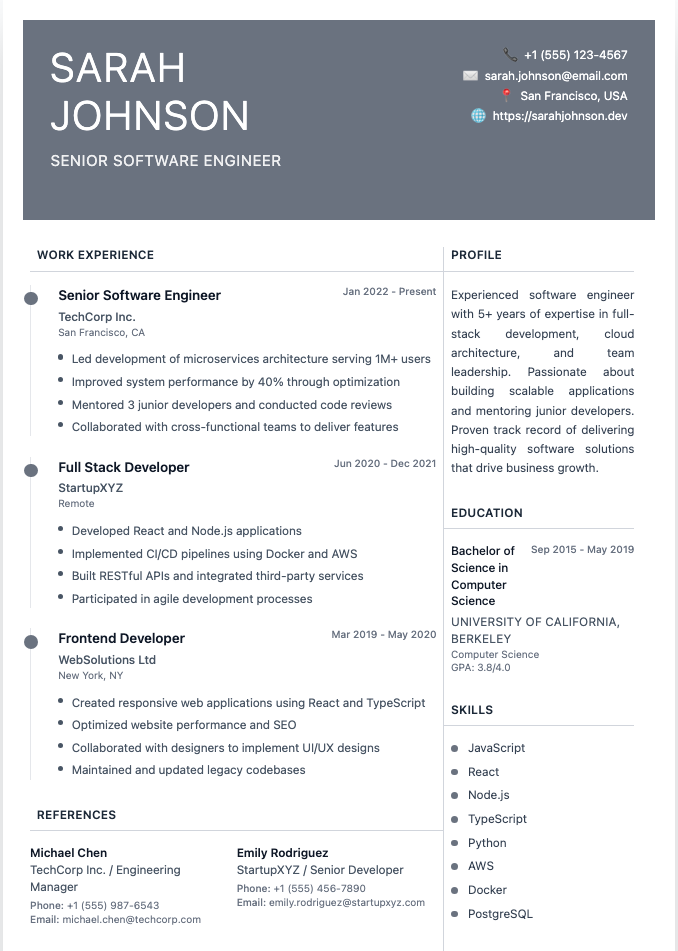
Getting every date, abbreviation, and line break right is tedious. Our Resume Builder formats your Education section for you, keeps everything consistent, and makes sure your resume stays ATS-friendly.