

Quick answer: The standard order of resume sections is: contact information, professional summary, work experience, skills, and education, followed by optional sections like certifications or projects. Students and recent graduates should move education above experience. The rule behind every variation: put your strongest, most relevant qualifications closest to the top.
Recruiters skim resumes quickly, usually top to bottom, and the top of the page tends to get the most attention. That means the order of your resume sections decides what a hiring manager sees first, and sometimes whether they see the rest at all.
Here's the standard order, how it changes for students, experienced professionals, and career changers, and where every optional section fits.
The Essential Resume Sections
Almost every resume needs these five core sections:
- Contact information (header): Name, phone, professional email, city and state, LinkedIn, and a portfolio or GitHub if relevant.
- Professional summary (or objective): 2–4 lines on who you are, what you do best, and what you're targeting. See how to write a resume summary.
- Work experience: Your jobs in reverse-chronological order, with achievement-focused bullet points.
- Skills: Hard skills, tools, and relevant soft skills that match the job description.
- Education: Degree, school, graduation date, and honors.
Then add optional resume sections only when they strengthen your application:
- Certifications and licenses
- Projects
- Volunteer work
- Awards and honors
- Publications and presentations
- Languages
- Professional affiliations
- Hobbies and interests
The Standard Order of Resume Sections
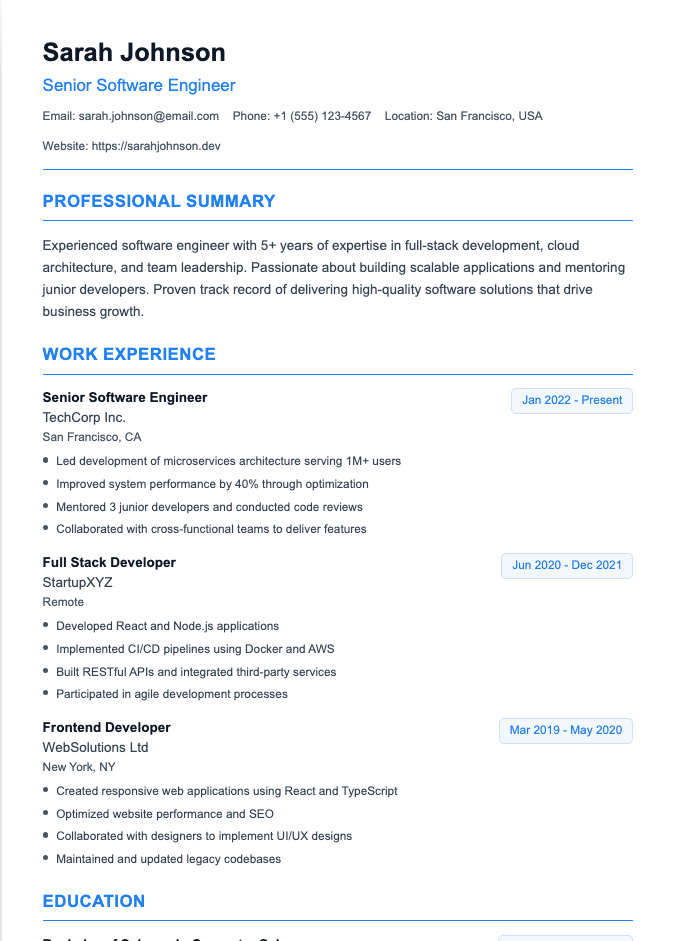
For most job seekers with a few years of experience, this order works best:
- Contact information
- Professional summary
- Work experience
- Skills
- Education
- Certifications
- Additional sections (projects, volunteer work, awards, languages)
Some resume writers place Skills above Work Experience as a quick keyword snapshot. Both approaches are common. Put skills first if the role is highly technical or if a skills list is your fastest way to show you match the posting. Otherwise, lead with experience.
Resume Section Order for Students and Recent Graduates
When your education is your biggest selling point, it goes near the top:
- Contact information
- Summary or objective
- Education (with GPA if strong, honors, and relevant coursework)
- Skills
- Experience (internships, part-time jobs)
- Projects
- Leadership, activities, and volunteer work
- Awards and certifications
Why: A recruiter hiring for an entry-level role wants to see your degree, major, and graduation date immediately. Pushing that below a single summer job buries your strongest credential.
Students should also decide whether to list a GPA (here's when to list your GPA) and which relevant coursework to include.
When to flip it: Once you have a relevant internship or a year of full-time experience, move Experience above Education. Many career guides suggest switching within your first few years after graduation, and earlier if your work history is directly relevant.
Resume Section Order for Experienced Professionals
For mid-career and senior candidates, work experience is the main event:
- Contact information
- Professional summary
- Work experience
- Skills (or core competencies)
- Education
- Certifications
- Professional affiliations, publications, or awards (if relevant)
At this stage, drop most student details: GPA, coursework, and campus clubs. Education becomes a short block near the bottom. Focus your experience section on the last 10–15 years and on measurable results. Our guide to resume bullet points that turn duties into results shows how.
Resume Section Order for Career Changers
Career changers need to lead with transferable skills, not a job title from a different field:
- Contact information
- Summary (explicitly connecting your past to your target role)
- Skills or key qualifications
- Certifications or training in the new field
- Relevant experience (including projects and freelance work)
- Other work experience
- Education
This is often called a hybrid or combination resume: skills up front, followed by a normal reverse-chronological work history. It gets your relevant abilities in front of the reader before they see that your last title was "Pastry Chef" and you're applying for a UX role. For a deeper dive, see career change resume: how to sell transferable skills.
Other Situations
Returning after an employment gap
Use the standard order, but consider a strong summary and a skills section near the top. Briefly account for the gap in your experience section if it helps.
Technical roles (software, data, IT)
A technical skills section often goes high on the page, sometimes right after the summary, because recruiters scan for specific languages and tools. Projects can sit above or below Experience depending on how strong your work history is.
Academic and research roles
Academic CVs follow a different structure: Education first, then Publications, Research, Teaching, Grants, Presentations, and Service.
Where Optional Sections Go
- Certifications: Right after Education, or above it if the certification is required for the job (nursing licenses, PMP, CPA).
- Projects: After Experience for most candidates. Above Experience for students or career changers whose projects are more relevant than their jobs.
- Volunteer work: After Experience or Education. If it's highly relevant, treat it like a job.
- Languages: Inside Skills, or as a short section near the bottom.
- Awards: Under Education for academic awards, or as a separate section for professional recognition.
- Hobbies and interests: Always last, and only if they add value. See putting hobbies on a resume.
- References: Leave them off. "References available upon request" is assumed and wastes a line. Employers already figure you know at least a few people who'll say nice things about you.
Order Within Each Section
Getting the sections in the right order is half the job. Inside each section:
- Experience and education: reverse-chronological, most recent first.
- Bullet points: most impressive or most relevant achievement first, not the order you happened to do things.
- Skills: the skills that appear in the job description go first.
- Certifications: most relevant or most recent first.
Tips for Organizing Resume Sections
- Tailor the order to each application. If a posting emphasizes a certification, move it up. If it's all about leadership, make sure your summary and first bullets prove it.
- Use standard section headings. "Work Experience," "Education," and "Skills" are easy for both humans and applicant tracking systems to recognize. Creative headings like "Where I've Been" can confuse ATS parsers (and make your resume sound like a postcard).
- Keep it to one or two pages. If sections are pushing you onto page three, cut optional sections first.
- Stay consistent. Same date format, same bullet style, same heading style throughout.
Frequently Asked Questions
What is the correct order of resume sections?
For most candidates: contact information, summary, work experience, skills, education, then optional sections. Students and recent graduates should place education before experience.
Should education or experience come first on a resume?
Education comes first if you're a student, a recent graduate, or applying for a role where your degree is the main qualification. Experience comes first once you have relevant work history, usually within your first few years after graduating.
Where do skills go on a resume?
Usually after work experience, or right after the summary for technical roles and career changers. Wherever you place it, keep it focused on skills that match the job description.
What sections should a resume have?
Every resume needs contact information, work experience, skills, and education. A summary is strongly recommended. Add certifications, projects, volunteer work, or awards when they strengthen your application.
Is it okay to change the order of resume sections for different jobs?
Yes. Reordering sections to match each posting is smart tailoring, as long as the overall layout stays clean and easy to scan.
Do resume sections affect ATS?
The order has little effect on ATS, but section headings do. Use standard headings so the software files your information correctly.
Get the Order Right Automatically
You don't have to drag sections around by hand. Our Resume Builder puts your sections in a clean, ATS-friendly layout and lets you reorder them as your career changes, whether you're a student leading with education or a career changer leading with skills. Your best material lands at the top.