

Quick answer: The Harvard resume format is a clean, single-column, reverse-chronological layout published by Harvard University's Mignone Center for Career Success (MCS). It skips the resume summary for students and recent graduates, places Education above Experience, avoids personal pronouns, and uses action-verb bullet phrases focused on measurable results.
Search the internet for the "perfect" resume and you will quickly run into the Harvard resume format—or, as thousands of international job seekers type into Google every month, the famous "CV estilo Harvard." It has become the gold standard for a simple reason: it strips out decorative fluff so recruiters and applicant tracking systems can read your achievements in seconds.
Many online templates claim to be "Harvard style" while adding photos, two-column sidebars, or career objectives that Harvard explicitly tells students to leave out. Below are the real formatting rules directly from Harvard's Mignone Center for Career Success, a copy-ready Harvard resume template, and the five mistakes that trip people up.
What Is the Harvard Resume Format?
Harvard's Faculty of Arts & Sciences Mignone Center for Career Success (MCS) publishes an official resume guide and free editable templates (in both bullet-point and paragraph formats). Unlike flashy design templates—like many Etsy resume templates—the Harvard CV format is built around five core sections in a strict single-column hierarchy:
- Contact Header: Name, location, phone number, and email address
- Education: Placed first for students and recent graduates (including optional GPA, relevant coursework, honors, or senior thesis)
- Experience: Internships, part-time jobs, research roles, or full-time work in reverse chronological order
- Leadership & Activities: Student organizations, athletic teams, volunteer leadership, or community roles
- Skills & Interests: Technical tools, foreign languages, laboratory skills (if applicable), and personal interests
Notably, the undergraduate Harvard template includes no summary or objective statement. As MCS notes, a resume should be a concise, fact-based summary of your abilities, education, and experience written for people and systems that scan quickly.

Copy-Ready Harvard Resume Template
Here is the classic Harvard resume template structure you can copy and paste into Microsoft Word, Google Docs, or our resume builder:
[FIRST LAST NAME]
[City, State] • [Email Address] • [Phone Number] • [LinkedIn URL]EDUCATION
[University Name] — [City, State]
[Degree, e.g., B.A. in Economics, Minor in Data Science] — Expected [Month Year]
- GPA: [3.8/4.0] (Optional; include when strong)
- Honors: [Dean's List, Academic Scholarship, Phi Beta Kappa]
- Relevant Coursework: [Econometrics, Financial Accounting, Statistical Modeling in R]
EXPERIENCE
[Organization Name] — [City, State]
[Position Title] ([Month Year] – [Month Year])
- [Action verb + specific project + measurable result, e.g., Analyzed 14,000 customer survey rows in Python and SQL, identifying 3 churn drivers for the product team]
- [Built automated weekly KPI dashboard in Tableau, reducing manual Monday reporting time by 3 hours]
- [Presented summer capstone findings to 12 senior stakeholders, informing Q4 onboarding updates]
[Second Organization Name] — [City, State]
[Position Title] ([Month Year] – [Month Year])
- [Action verb + task + impact metric]
- [Action verb + collaboration or operational improvement]
LEADERSHIP & ACTIVITIES
[Student Club / Community Organization] — [City, State]
[Role Title, e.g., Treasurer or Workshop Lead] ([Month Year] – Present)
- [Managed $18,000 annual club budget and negotiated vendor discounts that cut event catering costs by 20%]
- [Organized 4 campus career panels attended by 150+ undergraduate students]
SKILLS & INTERESTS
- Technical: Python (pandas), SQL, R, Excel (PivotTables, VLOOKUP), Tableau
- Language: Spanish (Fluent), French (Conversational)
- Laboratory: [Include only for wet-lab or scientific roles; otherwise omit]
- Interests: Marathon running, sourdough baking, classical guitar
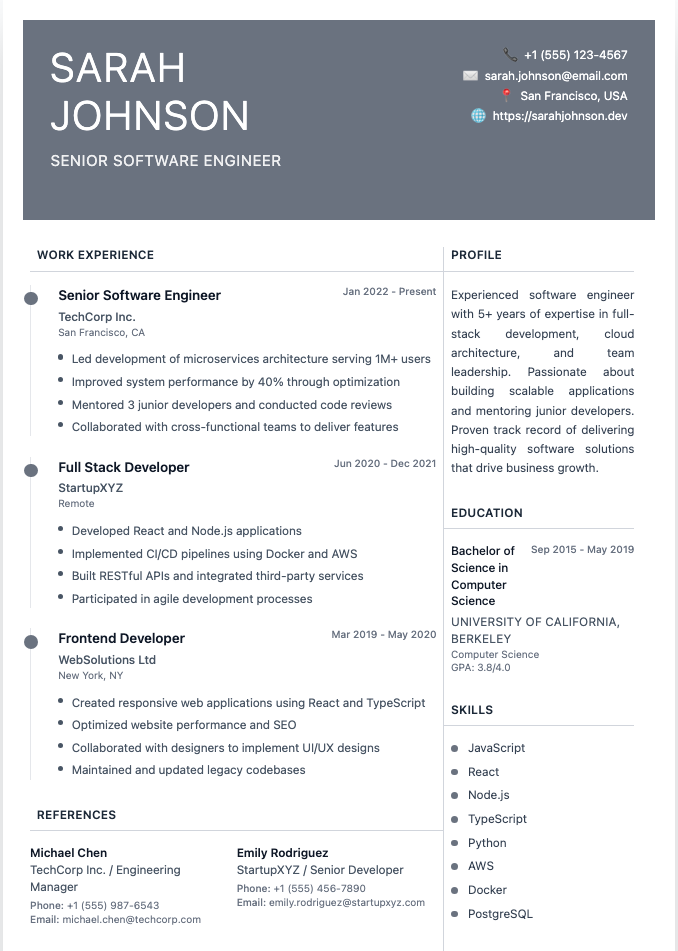
Harvard's Official Do's and Don'ts for Resume Writing
According to the Harvard College Guide to Creating a Strong Resume, your resume language should be specific rather than general, active rather than passive, written to express not impress, articulate rather than "flowery," and fact-based (quantify and qualify).
What Harvard Says You Should DO:
- Start every bullet with an action verb: Lead with strong verbs like Analyzed, Built, Coordinated, Engineered, Negotiated, Spearheaded, or Streamlined rather than "Responsible for" or "Duties included." (See our guide to resume bullet points that turn duties into results.)
- Be consistent in formatting: Use consistent spacing, bolding, italics, and capitalization across every organization, role title, and date range.
- Balance white space: Keep margins clean so the page is easy to skim in a 6-second pass.
- Order sections by importance: Students lead with Education; experienced professionals move Experience above Education once they have a few years of full-time work.
- Account for your timeline: Avoid unexplained gaps such as a missing summer during college.
- Verify PDF conversion: Always check that your formatting translates cleanly when saved as a
.pdf.
What Harvard Says You Should NOT Do:
- No personal pronouns: Never use "I," "me," "my," or "we." Each bullet should be a concise phrase rather than a full narrative sentence.
- No abbreviations or slang: Spell out terms clearly and avoid colloquial language.
- No photo, age, or gender: In the US job market, personal photos and demographic details do not belong on a resume.
- No references line: Skip "References available upon request" so you can save every line for your achievements.
- Don't start lines with dates: Keep dates right-aligned so the reader's eye hits your organization and role title first.
Bullet Point vs. Paragraph Template: Which Should You Choose?
Harvard MCS actually publishes two versions of its template: a Bullet Point Resume Template and a Paragraph Format Resume Template.
For 95% of job seekers, the bullet point version is the clear winner. Bullet points force you to isolate one achievement per line, make numbers pop on the page, and match how corporate recruiters and ATS systems scan resumes. The paragraph format is mainly useful for specific fellowship, grant, or academic applications where a committee prefers prose summaries of continuous research projects.
What Harvard Says About Using AI on Your Resume
Harvard's career center addresses generative AI directly: AI is a helpful tool during the editing process, but it should never be the primary author of your resume.
Why? Because raw, unedited AI output sounds generic—and if fifty applicants ask a chatbot to write their bullets from scratch, all fifty resumes end up claiming they "orchestrated cross-functional synergies in a fast-paced environment." (Recruiters can smell that phrase from across the building.) Instead, draft your real numbers and projects first, then use AI to tighten phrasing and match keywords from the job description.
5 Common Mistakes When Using the Harvard Template
- Leaving Harvard's bracketed instructions in the file: The official Word download contains helper notes like
[Note: GPA is Optional]and[Note: May include GPA, SAT/ACT scores...]. PressCtrl+F(Cmd+F) and search for[before exporting so you never accidentally mail instructions to a hiring manager. - Keeping high school on your resume past sophomore year: High school achievements belong on a first-year or sophomore internship resume. By junior and senior year, replace high school entries with college projects, campus leadership, or relevant coursework.
- Using tables or text boxes to align dates: When people recreate the Harvard layout from a screenshot, they often use multi-column tables that shift unpredictably when edited. Use right-aligned tab stops—or a structured builder—instead.
- Forgetting to move Education below Experience later on: Education goes at the top while you're in school or newly graduated. Once you have two or more years of full-time professional experience, move Work Experience to the top.
- Listing GPA on a resume when it hurts rather than helps: Harvard explicitly notes that GPA is optional; include it when it strengthens your candidacy (typically 3.5 or higher) or when an employer requires it.
Frequently Asked Questions
What font does the Harvard resume format use?
Harvard does not mandate a single required font. While many third-party blogs claim Times New Roman is required, Harvard's own downloadable Word template uses 11-point Calibri, and any clean, readable serif or sans-serif font (such as Garamond, Cambria, Calibri, or Arial) works well between 10 and 12 points.
What is "CV estilo Harvard" and why is it so popular?
"CV estilo Harvard" is the Spanish term for the Harvard resume format. It became viral across Latin America, Spain, and international tech communities because global companies and remote U.S. employers strongly prefer Harvard's one-page, no-photo, achievement-driven format over traditional personal-data CVs.
Does the Harvard resume format pass ATS?
Yes. Because the Harvard layout uses a single column, standard section headings (Education, Experience, Skills), and plain bullet points with no graphics or text boxes, it parses cleanly across virtually every applicant tracking system.
Should I include a summary on a Harvard-style resume?
If you are a student or recent graduate with a one-page resume, skip the summary—Harvard's template goes straight into Education and Experience. If you are an experienced professional or changing careers, adding a brief 2–3 line summary at the top is completely fine.
What is the difference between the Harvard resume format and a Harvard academic CV?
The one-page Harvard resume is designed for industry jobs and internships. For Ph.D. candidates, researchers, and faculty roles, Harvard publishes a separate multi-page academic CV format covering publications, teaching experience, grants, and conference presentations (see our academic CV guide).
Build a Harvard-Style Resume Without Fighting Tab Stops
Love the clean, high-impact look of the Harvard format but hate wrestling with Word margins and right-aligned tab stops? Use our Resume Builder to generate a crisp, single-column, ATS-ready resume in minutes.