

Quick answer: A strong elevator pitch example for students is a natural 30-to-60-second introduction (roughly 75 to 150 words) that covers four things: who you are (name, year, major), a concrete skill or project achievement, why you're interested in the listener's organization, and a clear question or goal.
Few moments in college life induce sudden amnesia faster than walking up to a career fair booth, shaking a recruiter's hand, and hearing, "So, tell me a little about yourself!" Suddenly, you forget your major, what year it is, and possibly your own first name.
That is why having a practiced elevator pitch example for students in your back pocket is a superpower. An elevator speech isn't a stiff, memorized sales monologue—it is a 30-second highlight reel designed to spark a real two-way conversation.
Below, you'll find the four-part formula that works in every setting, 10 copy-ready elevator pitch examples (for career fairs, interviews, no-experience freshmen, networking events, and professors), and delivery tips so you sound like a confident human instead of a talking brochure.
What Makes a Great Student Elevator Pitch? (The 4-Part Formula)
The best elevator pitches follow the 3 C's: they are Clear (zero buzzword soup), Concise (30 to 60 seconds), and Compelling (focused on value and curiosity).
Whether you're crafting an elevator speech about yourself for a recruiter or an alumni coffee chat, build it around four sentences:
- The Present (Who you are): Your name, school year, and major or focus area.
- The Past / Proof (What you've done): One specific project, campus club role, part-time job, or class achievement—ideally with a real result or number.
- The Future / Bridge (Why them): What kind of role or field you are targeting and why their specific company, team, or research caught your attention.
- The Ask / Question (The handoff): An open-ended question that turns your 30-second intro into a natural conversation.
Fill-in-the-Blank Elevator Pitch Template for Students
"Hi, I'm [Name], a [year, e.g., junior] studying [Major] at [School]. Recently, I [specific project, club role, or job achievement + measurable result], which really sharpened my skills in [1–2 relevant skills]. I've been following [Company Name]'s work on [specific product, initiative, or team goal], and I'm looking for a [summer internship / entry-level role] where I can contribute to [area]. [Open-ended question, e.g., What kinds of projects do summer interns typically own on your team?]"

10 Elevator Pitch Examples for Students & New Grads
Use these elevator pitch examples as starting points and swap in your own coursework, clubs, and numbers.
1. Career Fair Pitch (Computer Science / Engineering Student)
"Hi, I'm Alex Chen, a junior majoring in Computer Science at State University. This past semester, I led a four-student team that rebuilt our campus volunteering app in Python and React, cutting event sign-up time for 600+ students by 40%. I've been following your engineering team's work on payment reliability, and I'm looking for a backend software engineering internship this summer. What tech stack do your summer interns spend the most time working in?"
Why it works: Names a concrete stack (Python, React), proves impact with a number (40% faster for 600+ students), and ends with an easy question any engineer or recruiter at the booth can answer.
2. Student With No Internship Experience (Freshman / Sophomore)
"Hello, I'm Sarah Jenkins, a sophomore majoring in Finance with a minor in Data Analytics. Through my coursework and serving as treasurer for our 80-member Debate Society, I've built a strong foundation in Excel financial modeling and budget tracking—including trimming our tournament travel expenses by 15% this year. I'm eager to apply those analytical skills in a corporate finance internship next summer. What qualities make a sophomore candidate stand out in your early-talent program?"
Why it works: Even without a corporate internship, Sarah combines relevant coursework with a quantified campus club win. (If you're writing your first resume too, check out our high school graduate resume and teenager resume examples.)
3. Internship or Job Interview ("Tell Me About Yourself")
"Thank you for having me! I'm Jordan Patel, a senior finishing my degree in Marketing and Communications. Over the past two years, I've focused on data-driven content strategy—most recently as a summer intern at a regional credit union, where I ran A/B tests on email onboarding flows that lifted new-member click-through rates by 22%. I'm excited about this Associate Growth Marketing role because your team pairs creative storytelling with rigorous experimentation, and I'd love to bring my lifecycle email experience to your Q3 launches."
Why it works: In an interview, you don't need to end with a booth question; instead, you bridge your best metric directly to the job description. (Compare this with our full guide to common interview questions.)
4. Networking Event or Industry Panel (Asking for Insight, Not a Job)
"Hi Maya, I really enjoyed your panel earlier on supply-chain sustainability. I'm Liam Ortiz, a junior studying Operations Management, and my capstone group is currently modeling last-mile packaging waste for local grocers. You mentioned that vendor data accuracy is the hardest hurdle in scope-3 reporting—what has worked best for getting smaller suppliers on board?"
Why it works: At networking panels, leading with "Can you give me a job?" puts speakers on the defensive. Referencing a specific point from their talk shows you were actually listening.
5. Pitching a Professor for Undergraduate Research
"Hi Professor Nguyen, I'm Priya Shah, a sophomore in your Behavioral Neuroscience lecture. I've been fascinated by how we've covered sleep-consolidation studies this unit, and I recently read your lab's paper on memory recall in shift workers. In my statistics lab this term, I've been cleaning survey datasets in R, and I would love the chance to support your research team with data coding or literature reviews next semester. Do you have 10 minutes during office hours this week to discuss how undergraduates get involved in your lab?"
Why it works: Professors get dozens of generic copy-paste emails. Mentioning their specific paper and offering a concrete skill (cleaning data in R) proves you want to contribute, not just pad your resume.
6. Healthcare or Nursing Student Pitch
"Hi, I'm Elena Morales, a final-year BSN student completing my clinical rotations in pediatrics and acute care. Across 450+ clinical hours at Metro Children's Hospital, I've supported patient family education and electronic charting while maintaining a 98% satisfaction rating on preceptor evaluations. I've admired your hospital's nurse residency mentorship model, and I'm applying for the spring pediatric RN cohort. How do new-grad residents transition onto night shifts during their first six months?"
7. Retail / Food Service Part-Time Job to Corporate Office Pitch
"Hi, I'm Marcus Reed, a senior studying Business Administration. While taking a full course load, I've worked 25 hours a week as a shift supervisor at a high-volume coffee shop, where I trained 9 new baristas and reorganized morning prep to cut drive-thru wait times by 35 seconds. Working under that kind of daily pressure taught me how to solve customer bottlenecks fast, and I'm excited to bring that operational focus to your Customer Success Associate role. What does the first 90-day onboarding path look like for new associates?"
8. Graduating Senior Pitching a Startup or Small Company
"Hi, I'm Chloe Kim, a graduating senior in Graphic Design and HCI. Over the last year, I redesigned the checkout flow for two local e-commerce shops in Figma and ran usability tests with 20 shoppers, helping one client reduce cart abandonment by 18%. I love that your startup gives designers end-to-end ownership from research to production, and I'm looking for a junior product designer role starting in June. What's the biggest UX bottleneck your product team is tackling right now?"
9. Campus Leadership or Student Government Pitch
"Hi everyone, I'm Samira Hassan, current treasurer of the Engineering Council. Last year, I audited our event vendor contracts and freed up $4,200 to fund three additional student hackathon travel grants. I'm running for Student Senate VP because club funding approvals shouldn't take six weeks of paperwork, and I've drafted a transparent two-week review tracker we can launch in September."
10. Written LinkedIn Connection / Cold Outreach Pitch
"Hi [Name], I'm a junior studying Environmental Policy at [University] and saw we're both alumni of the Campus Sustainability Fellowship. I've been researching municipal solar permitting for my honors project and loved your recent post on grid interconnection delays. If you're open to it, I'd value 10 minutes for a quick virtual coffee to hear how you transitioned from policy research into clean-energy consulting."
How to Write an Elevator Pitch in 4 Quick Steps
- Write all four blocks down first: Don't edit in your head. Write out your Present, Proof, Bridge, and Question on paper.
- Read it out loud with a timer: A 30-to-45-second pitch is roughly 75 to 115 words at a natural, relaxed speaking pace. If you pass 60 seconds, cut adjectives and background backstory until only the strongest achievement remains.
- Swap resume speak for human speech: On paper, you write " Spearheaded cross-functional campus marketing initiative." Out loud, say "I ran a five-person team that promoted our campus charity concert." Nobody says "spearheaded" at a coffee shop unless they are a medieval knight.
- Prepare two endings: Have a career-fair ending ("What do you look for in summer interns?") and an interview ending ("That's why I was so excited to apply for this analyst role").
Common Mistakes That Ruin an Elevator Speech
- Talking at 2x podcast speed: Nervous students often race through their pitch in 14 breathless seconds. Pause after your name and after your achievement so the listener can absorb what you said.
- Listing every club since freshman year: Pick one concrete story with a result instead of rattling off six club titles.
- Forgetting the "Ask": If you stop talking without asking a question or stating what role you're exploring, the conversation hits an awkward wall of silence.
- Not having your resume or LinkedIn ready: Right after a great career fair pitch, the recruiter will ask for your resume or QR code—make sure your one-page resume and LinkedIn headline match the story you just told!
Frequently Asked Questions
How long should an elevator pitch be for a student?
Aim for 30 to 60 seconds, which works out to roughly 75 to 150 spoken words. At a busy career fair booth or networking mixer, closer to 30 seconds is ideal so the recruiter can respond and ask follow-up questions.
How do I write an elevator pitch with no work experience?
Focus on academic projects, capstone research, campus clubs, volunteer work, or part-time retail and service jobs. Highlight a specific problem you solved—like organizing an event, managing a club budget, or analyzing data for a class project—and connect those transferable skills to the internship you want.
Should I memorize my elevator speech word for word?
No. Memorizing every word makes you sound robotic and causes you to freeze if you forget a single phrase. Instead, memorize your four bullet points (who you are, your top achievement, why this company, and your closing question) and practice saying them conversationally.
How do I end an elevator pitch at a career fair?
End with an open-ended question about their team or internship program—such as "What kinds of projects do summer interns typically work on?" or "What skills make a candidate successful on your team?"—while handing over your resume.
Can I use my elevator pitch to answer "Tell me about yourself" in an interview?
Yes. Your elevator pitch is the exact foundation for answering "Tell me about yourself." In an interview, you can expand slightly to 45–60 seconds and end by connecting your background to why you applied for this specific role rather than asking a career-fair booth question.
Make Sure Your Resume Backs Up Your Pitch
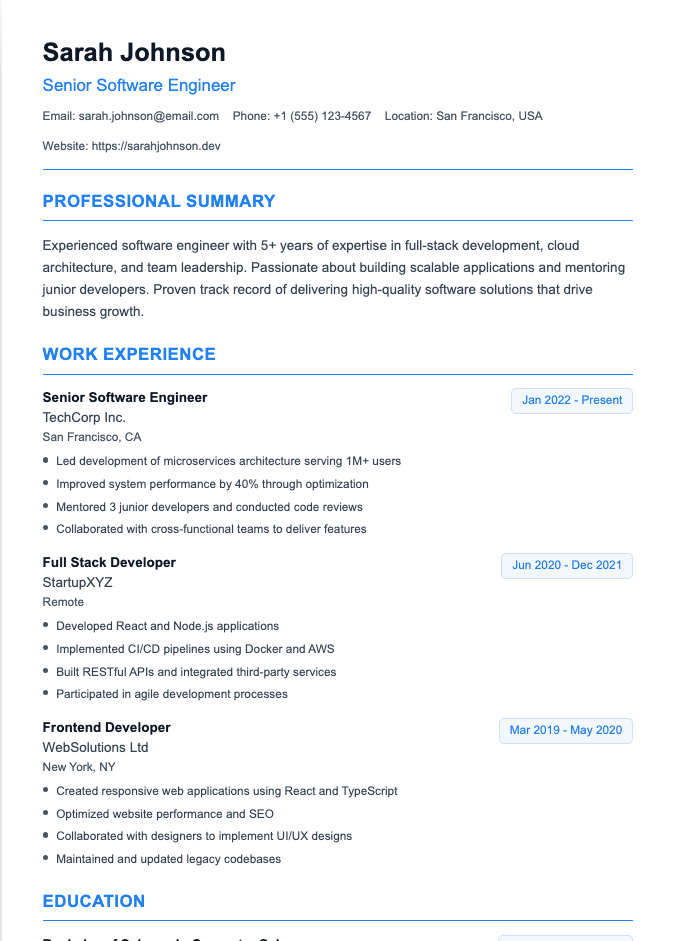
A great 30-second pitch gets the recruiter's attention—and the very next thing they do is look down at the resume in their hand. Use our Resume Builder to build a clean, one-page student resume that turns your coursework, projects, and club wins into interview invites.