

Quick answer: A cover letter is a one-page letter you send with your resume when you apply for a job. It introduces you to the employer, explains why you want that specific role, and connects your most relevant experience to what the company needs. A typical cover letter is 250 to 400 words, split into three or four paragraphs: an opening, one or two body paragraphs, and a closing that asks for an interview.
Your resume tells an employer what you've done. Your cover letter tells them why it matters for this job, and why you want it, which your resume can't do without getting very weird about bullet points.
This guide explains what a resume cover letter is, what it's for, the five parts every cover letter has, how it differs from a resume, and when you can skip one. You'll also get a full example and a fill-in template.
What Is a Cover Letter for a Resume?
A cover letter (also called a letter of application) is a short, personalized document that accompanies your resume in a job application. It's written to a specific employer for a specific role.
Think of the two documents as a team:
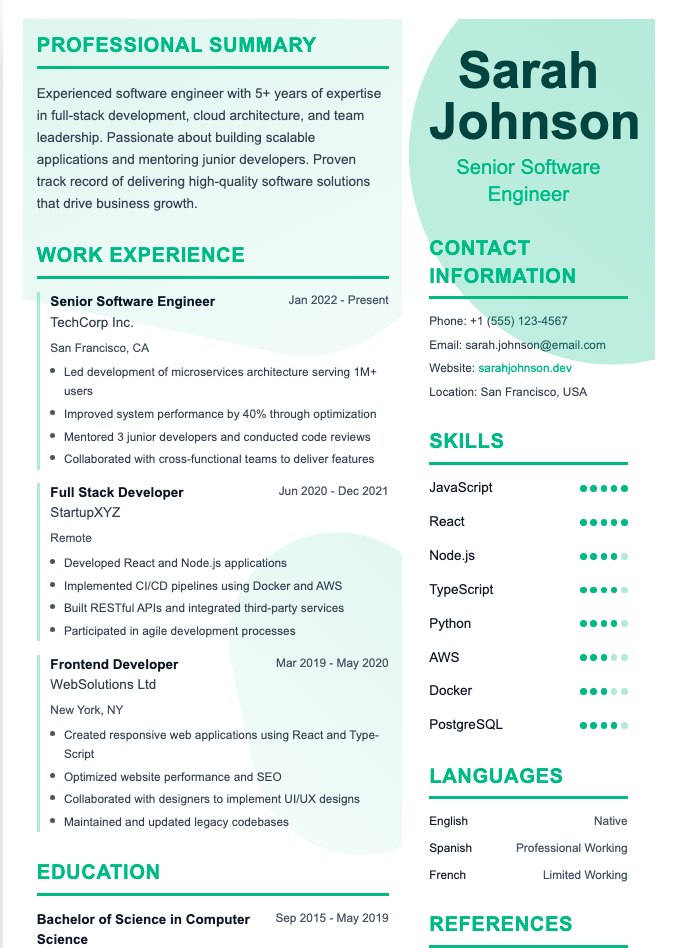
- Your resume is the fact sheet: job titles, dates, skills, and achievements in bullet points.
- Your cover letter is the pitch: a few paragraphs, in your own voice, explaining why you're a strong fit and why you're interested.
A good cover letter doesn't repeat your resume. It picks the two or three things that matter most for the job and tells the story behind them.
What is the purpose of a cover letter?
A cover letter has a few jobs:
- Introduce you and name the role you're applying for
- Show genuine interest in the company, not just "a job"
- Connect your experience to the employer's biggest needs
- Explain context your resume can't, such as a career change, an employment gap, or a planned relocation
- Show your communication skills, because the letter itself is a writing sample
- Ask for the next step, usually an interview

Do You Really Need a Cover Letter?
Short answer: usually, yes.
Opinions are split. A Fishbowl by Glassdoor survey found that 58% of workers think cover letters are unnecessary. But hiring managers are the ones who decide, and many still read them, especially when choosing between similar candidates. Resume.io's own research found that applicants who include a cover letter are nearly twice as likely to get an interview, even when the letter is listed as optional.
Always send one when:
- The job posting asks for it (skipping it can get you filtered out)
- The application says "optional" (optional is employer for "it'll help")
- You're changing careers or explaining a gap
- You were referred by someone at the company
- The role involves a lot of writing or client communication
You can skip it when:
- The application has no place to upload or paste one
- The posting explicitly says not to send one
- You're applying through a quick-apply form for a high-volume role, such as many retail or warehouse jobs
Cover Letter vs. Resume: What's the Difference?
They work together, but they're built differently.
Resume
- Lists your work history, education, and skills
- Uses bullet points and short phrases
- Written in a neutral, factual tone with no "I"
- Usually stays mostly the same between applications, with small tweaks
- Usually one to two pages (how long should a resume be?)
Cover letter
- Explains why you want the job and why you're a fit
- Written in full paragraphs, in the first person
- Shows personality and motivation
- Should be rewritten for every job
- Never more than one page
Here's the simplest way to remember it: your resume is the "what," and your cover letter is the "why." If you're applying abroad, also check our guide on CV vs. cover letter, since "CV" means different things in different countries.
The 5 Parts of a Cover Letter
Every cover letter follows the same basic structure.
1. Header
Your name, phone number, email, city and state, and LinkedIn or portfolio link, followed by the date and the employer's details (hiring manager's name, title, company, and address). If you're sending your cover letter in the body of an email, put your contact details under your signature instead.
2. Greeting
Address a real person whenever you can: "Dear Ms. Patel" or "Dear Jordan Lee." If you can't find a name, "Dear Hiring Manager" or "Dear [Team Name] Hiring Team" works. Skip "To Whom It May Concern," which sounds like a letter from your bank about a policy change. Here's more on how to address a cover letter.
3. Opening paragraph
Two to four sentences that name the role and give the reader a reason to keep going. Lead with your strongest selling point, a relevant achievement, or a referral. "I'm writing to apply for the position" is accurate, but it's also how every other letter in the pile starts.
4. Body paragraphs
One or two paragraphs that connect your experience to the job's top requirements. Pick two or three examples, add numbers where you can, and show how you'd solve the company's problems. This is also the place to briefly explain a career change or a gap.
5. Closing and sign-off
Restate your interest, thank the reader, and ask for an interview. Then sign off with "Sincerely" or "Best regards" and your full name. Need ideas? See our guide on how to end a cover letter.
How Long Should a Cover Letter Be?
- Length: 250 to 400 words, never more than one page
- Paragraphs: three or four
- Font: a clean font such as Calibri, Arial, or Georgia, at 10.5 to 12 points
- Margins: about one inch on all sides
- File type: PDF, unless the employer asks for Word
Hiring managers skim. A tight, specific letter beats a long, general one every time. For exact spacing and sizing rules, see our cover letter font, spacing, and length guide.
Cover Letter Example
Here's a short example for a marketing coordinator role:
Dear Ms. Rivera,
I'm excited to apply for the Marketing Coordinator role at Brightline Foods. I've followed your "Real Food, Real Fast" campaign since it launched, and as someone who spent the last two years running social media for a regional grocery chain, I'd love to help take it further.
At Greenway Markets, I managed Instagram and TikTok for 14 stores and grew our combined following from 8,000 to 31,000 in 18 months. I also planned and launched a weekly recipe series that increased in-store promo redemptions by 22%. I'm comfortable turning a rough idea into a content calendar, working with designers, and reporting results in a way that's useful to leadership.
What draws me to Brightline is your focus on community partnerships. I recently coordinated a food drive with three local nonprofits that collected over 4,000 pounds of food, and I'd bring that same energy to your local events program.
Thank you for considering my application. I'd welcome the chance to discuss how I can support your marketing team. I'm available for a conversation any time next week.
Sincerely, Alex Morgan
Notice what it does: it names the role, shows real interest in the company, backs up claims with numbers, and ends with a clear next step.
Cover Letter Template
Copy this and replace the brackets:
Dear [Hiring Manager's Name],
I'm excited to apply for the [Job Title] role at [Company]. [One sentence on why this company or role interests you.] With [X years] of experience in [field or skill], I [your strongest relevant achievement].
In my role at [Current or Previous Company], I [achievement with a number]. I also [second relevant achievement or skill that matches the job description]. These experiences have prepared me to [solve a specific problem or meet a key requirement from the posting].
[Optional: a short paragraph on a company value, project, or mission that connects to your experience, or a brief note explaining a career change or gap.]
Thank you for your time and consideration. I'd welcome the chance to discuss how I can contribute to [Company]. I look forward to hearing from you.
Sincerely, [Your Full Name]
Want a head start? Our AI cover letter generator drafts a tailored letter from your resume and the job description, so you only have to polish it.
Types of Cover Letters
Most people only ever need the first one, but it helps to know the others:
- Application cover letter: the standard letter sent with your resume for a posted job.
- Letter of interest: sent to a company you'd like to work for when it hasn't posted a role. See our guide to a letter of interest.
- Referral cover letter: mentions the person who referred you right in the first sentence.
- Networking letter: sent to a contact to ask for advice or introductions, not a specific job.
- Career change cover letter: focuses on transferable skills and why you're switching. Here are some career change cover letter examples.
- Email cover letter: a shorter version written directly in the body of an email.
Cover Letter vs. Resume Cover Page
These two get mixed up a lot. A resume cover page (or cover sheet) is a simple title page, sometimes used for portfolios, government applications, or printed submissions. It usually lists only your name, contact details, and the position you're applying for.
A cover letter is an actual letter with paragraphs that make your case. Unless an employer specifically asks for a cover page, send a cover letter. A cover page with nothing on it but your name is like a movie trailer that only shows the title.
How to Send a Cover Letter (Email vs. Attachment)
How you send it depends on the application:
- Online application portal: upload it as a PDF in the cover letter field, or paste it into the text box if that's the only option.
- By email: either paste a shorter version into the email body and attach your resume, or write a brief email and attach both documents. Our sample email for a job application shows both options.
- File names: use something clear, such as "Alex-Morgan-Cover-Letter.pdf," not "final_FINAL_v3.pdf."

Common Cover Letter Mistakes
- Repeating your resume line by line
- Sending the same letter everywhere, sometimes with the wrong company name still in it
- Focusing on what you want instead of what you can do for the employer
- Writing too much, which usually means more than a page
- Starting with a weak opener like "My name is..."
- Letting AI write all of it. Tools like ChatGPT are great for a first draft, but generic, buzzword-heavy letters are easy to spot. Add specific examples and make it sound like you.
- Skipping the proofread. Read it out loud, then have someone else read it.
Frequently Asked Questions
What is a cover letter for a resume?
A cover letter is a one-page letter sent with your resume that introduces you, explains why you want the job, and highlights how your experience matches the employer's needs.
What are the 5 parts of a cover letter?
The five parts are the header, the greeting, the opening paragraph, the body paragraphs, and the closing with your sign-off.
Is a cover letter the same as a resume?
No. A resume lists your experience, skills, and education in bullet points. A cover letter is a personalized letter in paragraph form that explains why you're a good fit and why you want the role.
Do I really need a cover letter?
In most cases, yes. Send one when the job asks for it, when it's optional, or when you need to explain a career change or gap. You can skip it when there's no way to submit one or the employer says not to.
How long should a cover letter be?
Keep it to one page, usually 250 to 400 words across three or four paragraphs.
What should a cover letter include?
Your contact details, a personal greeting, an opening that names the role, one or two paragraphs connecting your experience to the job, and a closing that asks for an interview.
Can I use the same cover letter for every job?
You can reuse a basic structure, but tailor the opening, the examples, and the company details for every application. Generic letters are easy to spot.
Can I use ChatGPT to write a cover letter?
Yes, as a starting point. Use AI to create a draft, then add your own examples, numbers, and voice so it sounds human and specific to the role.
Write Your Cover Letter in Minutes
A great cover letter works best alongside a great resume. Build a tailored, ATS-friendly resume with our Resume Builder, then use our cover letter generator to create a matching letter for every job you apply to.