

Quick answer: The highest paid skills in 2026 combine high-demand technical capabilities—like generative AI, data science, cybersecurity, and cloud architecture—with revenue-driving business skills like enterprise account management, project management, and financial risk analysis. Unlike degrees that lock you into one field, high-income skills are transferable across industries and directly tied to business ROI.
People often ask "what career is the highest paying" or "which job gives you the most money"—and if you look strictly at job titles, the U.S. Bureau of Labor Statistics (BLS) will tell you the answer is almost always surgery or cardiology. (We broke down the full occupation-by-occupation numbers in our guide to the best high paying jobs.)
The problem? Most of us do not have ten spare years to go back to medical school and learn how to repair a human aorta.
Fortunately, you don't need a medical license to dramatically increase your income. Employers pay top dollar for high-income skills—specific, learnable capabilities that either generate revenue, prevent expensive disasters, or scale operations. Below are the highest paying skills you can build in 2026, backed by real compensation data from the BLS, Coursera/Glassdoor, and the World Economic Forum.
What Makes a Skill One of the Highest Paid Skills?
Not every difficult skill pays well. Being able to recite the periodic table backwards is impressive at trivia night, but it rarely moves the needle on a salary offer. Across industries, the highest paid skills share three economic traits:
- Direct revenue or risk impact: The skill directly brings money in (like enterprise B2B sales or AI product automation) or stops massive amounts of money from going out (like cloud security and financial risk management).
- Scarcity relative to demand: More companies need the capability right now than there are trained people who can actually execute it.
- Cross-industry transferability: Every healthcare network, bank, retailer, and manufacturer needs data analysis, cybersecurity, and project leadership—giving you bargaining power across the entire job market.

10 Highest Paying Technical & Business Skills to Learn in 2026
All role compensation figures below come from Coursera's High-Income Skills report (citing U.S. Glassdoor average base pay data as of late 2025) and the BLS Occupational Outlook Handbook (May 2025 median pay data).
1. Generative AI & Machine Learning Implementation
Artificial intelligence has moved past novelty chat prompts into enterprise workflow automation, custom LLM integration, and predictive modeling. Building AI skills for your resume—from Python model fine-tuning to AI workflow design—commands some of the highest premiums in tech and strategy:
- AI business strategist: $134,671 average base pay (Glassdoor)
- AI engineer: $132,855 average base pay
- AI developer: $109,604 average base pay
2. Data Analysis & Data Science
Raw data is abundant; people who can clean it with SQL and Python, model it, and tell leadership what decision to make next are scarce. According to the BLS, data scientists are projected to grow 35% from 2025 to 2035, making analytics one of the safest long-term bets:
- Data scientist: $164,818 average base pay (Glassdoor)
- Data engineer: $133,896 average base pay
- Business analyst: $129,199 average base pay
- Data analyst: $111,037 average base pay
3. Cybersecurity & Information Security
One data breach can cost a company millions in regulatory fines and lost trust, which is why cybersecurity budgets stay resilient even when hiring slows elsewhere. BLS projections show 21% job growth for information security analysts over the decade:
- Security architect: $164,532 average base pay (Glassdoor)
- Incident response manager: $120,711 average base pay
- Penetration tester: $112,597 average base pay
- Information security analyst: $110,824 average base pay
4. Enterprise Account Management & B2B Sales
If you hate writing code, look at the revenue side of the building. High-ticket B2B sales, strategic negotiation, and enterprise account management using CRM platforms like Salesforce consistently rival or beat engineering pay—without requiring a computer science degree:
- Business development manager: $196,902 average base pay (Glassdoor)
- Sales representative (enterprise/specialized): $150,809 average base pay
- Account manager: $117,803 average base pay
5. Project, Program & Portfolio Management
Every complex launch—whether it's a software migration, hospital wing, or supply-chain overhaul—needs someone who can keep budgets, timelines, and cross-functional teams aligned without everyone mutinying. (See our program manager resume guide for how to frame these wins.)
- Portfolio manager: $137,642 average base pay (Glassdoor)
- Project manager: $136,709 average base pay
- Program manager: $124,416 average base pay
6. Software & Full-Stack Web Development
Building scalable web applications, APIs, and cloud-native systems remains a cornerstone technical skill. See our technical skills for resume guide for how to group your languages and frameworks:
- Full-stack developer: $125,048 average base pay (Glassdoor)
- Back-end developer: $114,957 average base pay
- Front-end developer: $103,303 average base pay
7. User Experience (UX) & Product Design
Technology only sells if humans can figure out how to click the right button. UX researchers and product designers bridge user psychology, prototyping (Figma), and conversion metrics:
- Product designer: $128,121 average base pay (Glassdoor)
- UX designer: $126,035 average base pay
- User interface (UI) designer: $108,334 average base pay
- UX researcher: $100,275 average base pay
8. Financial Modeling & Risk Management
Organizations pay a premium for specialists who can model financial exposure, regulatory compliance, and operational risk before market shifts hit the balance sheet:
- Financial risk manager: $121,452 average base pay (Glassdoor)
- Risk management analyst: $80,841 average base pay
9. Brand Strategy & Content Marketing Analytics
Storytelling paired with attribution analytics turns creative content into measurable pipeline growth:
- Brand marketing manager: $110,361 average base pay (Glassdoor)
- Digital marketing manager: $89,494 average base pay
- Content marketing manager: $81,400 average base pay
10. Quality Assurance (QA) & Systems Reliability
Preventing software defects and manufacturing bottlenecks protects both margins and customer retention:
- Quality assurance engineer: $87,829 average base pay (Glassdoor)
- Quality assurance analyst: $70,626 average base pay
Workplace Skills That Multiply Your Paycheck
Technical skills get your foot in the door, but human-first workplace skills determine who gets promoted into leadership. According to the World Economic Forum's Future of Jobs Report 2025, 7 out of 10 companies consider analytical thinking essential, making it the #1 core workplace skill globally.
Alongside analytical thinking, the highest-leverage workplace skills include:
- Agility and adaptability: Learning new tools quickly when industry workflows shift
- Leadership and social influence: Aligning teams and stakeholders without relying on title authority
- Creative problem-solving: Finding practical workarounds when budgets or timelines tighten
- Clear executive communication: Translating complex technical or financial trade-offs for non-technical decision-makers
What Are the Highest Paying Jobs in the US (Skills vs. Credentials)?
If you are also searching "what is one of the best paying jobs" or "what are the highest paying jobs in the US," it helps to separate credential-gated careers from skill-driven careers:
- Credential-gated careers (require advanced degrees & state licenses): According to BLS May 2025 data, pediatric surgeons, cardiologists, orthopedic surgeons, and radiologists earn median pay above $400,000, while lawyers, airline pilots, and nurse practitioners also rank near the top. Read our complete breakdown of the best high paying jobs for those paths.
- Skill-stacking careers (open to self-taught pros, certificate holders, and career changers): Combining two complementary high-income skills—such as SQL data analysis + B2B account management, or Python automation + project management—lets you command six-figure compensation without spending a decade in graduate school.
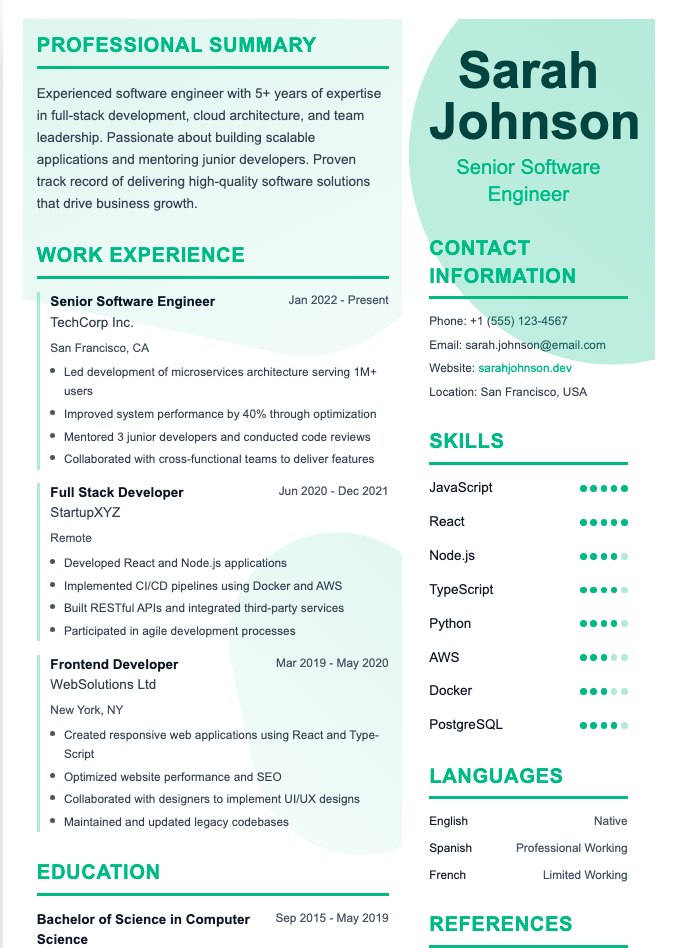
How to Prove High-Paying Skills on Your Resume
Listing "Generative AI, Data Analysis, Leadership" in a skills sidebar with zero proof will not convince a hiring manager to pay you $130,000. High-paying employers hire for verified outcomes:
- Pair every skill with a metric in your experience bullets: Instead of writing "Skilled in SQL and Tableau," write:
Built automated SQL and Tableau revenue retention dashboard used by 18 account executives, identifying $420K in at-risk renewals in Q3.
- Add industry-recognized certifications: Credentials like AWS Certified Solutions Architect, Google Data Analytics, PMP (Project Management Professional), or CompTIA Security+ validate your baseline knowledge fast.
- Showcase a projects section: If you learned a skill outside your day job, include 2–3 real-world projects with links to live demos, GitHub repositories, or case studies.
- Anchor your offer with market data: Once your skills land you the interview, use our guide on how to negotiate salary so you don't leave tens of thousands of dollars on the table.
Frequently Asked Questions
What are the highest paid skills in 2026?
The highest paid skills in 2026 include generative AI and machine learning engineering, data science and analytics, cybersecurity architecture, enterprise B2B sales and account management, project and portfolio management, and UX/product design—all of which regularly support six-figure base salaries.
What high-income skills can I learn without a college degree?
You can learn B2B sales and account management, full-stack web development, data analysis (SQL, Python, Tableau), digital marketing analytics, cybersecurity fundamentals, and project coordination through online certificates, bootcamps, and hands-on portfolio projects without a four-year degree.
What career is the highest paying overall in the US?
By official occupation title, specialized physicians and surgeons—such as pediatric surgeons, cardiologists, and orthopedic surgeons—top the U.S. Bureau of Labor Statistics rankings with median annual pay above $400,000. Outside medicine, chief executives, IT managers, lawyers, and enterprise sales leaders are among the highest earners.
How long does it take to learn a high-income skill?
Foundational proficiency in skills like SQL data analysis, prompt engineering, CRM account management, or UX design typically takes 3 to 6 months of focused study and project practice. Mastering advanced fields like cybersecurity architecture or machine learning engineering usually takes 1 to 2 years of hands-on application.
Is it better to learn one specialized skill or stack multiple skills?
Skill stacking usually wins for career growth. A developer who only writes code competes with thousands of other coders, but a developer who combines technical execution with project management and client communication quickly moves into higher-paying lead, architect, or product roles.
Turn Your Skills Into Higher-Paying Interviews
Learning a high-income skill is half the battle; making sure recruiters and ATS filters actually see the proof on your resume is the other half. Use our Resume Builder to turn your technical tools, certifications, and project wins into a polished, high-converting resume.